




.jpg?la=en&h=170&w=310&hash=1B44A4619EFA8E406DA32569632545B3)

 Deutschland
 India
India Lietuva
 United Kingdom
 Search
 Search



Families trying to make their homes more efficient often find themselves in a maze: one application for weatherization, another for tax credits, a third for rebates—and no clear place to start. State and local agencies see the same fragmentation from the inside, in the form of overlapping eligibility rules, separate data systems, and limited capacity to stack and braid funding sources.
A well-designed one-stop shop or “single front door”—a system that unites fragmented programs under one operational and customer experience framework—changes the equation. It organizes service delivery around the resident journey rather than agency boundaries. The most successful models are defined by disciplined coordination—shared eligibility rules, data interoperability, trained navigators, and performance management systems that make it possible for multiple programs to function as one coherent experience. While many see technology systems as the silver bullet for effective one-stop shops, more than anything, the key ingredient for success is the interagency collaboration (and related silo busting) that facilitates these kinds of shared tools and systems.
As states expand clean energy initiatives (and other complex public programs), the challenge is no longer what to offer but how to help residents act. A single front door to these programs can transform complex funding streams into visible, accessible, and equitable opportunities.
A one-stop shop turns a government program with complicated rules into a seamless experience for households by eliminating friction in a few key ways:
For state agencies, a single front door reduces duplication, improves data quality, and makes program outcomes easier to measure. Most important, it turns a patchwork of initiatives into a frictionless customer experience and, if done right, becomes the backbone of a state’s home energy strategy.
All successful one-stop shops share a few key features that define what the system should do for households and contractors, regardless of who manages it. One-stops should be:
Together, these features make the one-stop shop an operational bridge between agencies and the people they serve.
Putting these principles into action requires a few core building blocks:
Models in practice: Three paths to integration
States can design one-stop shops in different ways depending on how much coordination they can support. The best solution is an agile one that can accommodate varying levels of inter-agency and program buy-in, but agencies can start by considering three potential models:
What distinguishes high-performing programs, however, is not the model itself but how well it is executed, how seamlessly data flows, how effectively accountability is shared, how clearly customer experience is measured, and how well the program iterates to improve over time.
The strongest programs share a few management practices that keep them running smoothly. They start small—often by integrating eligibility between two large programs—and they designate an owner or lead agency to collect, maintain, and de-conflict information across partners and stakeholders.
Identifying and tracking key metrics, such as those shown below, is also critical. Doing so allows states to monitor implementation, identify areas for improvement, and publicly communicate achievements.
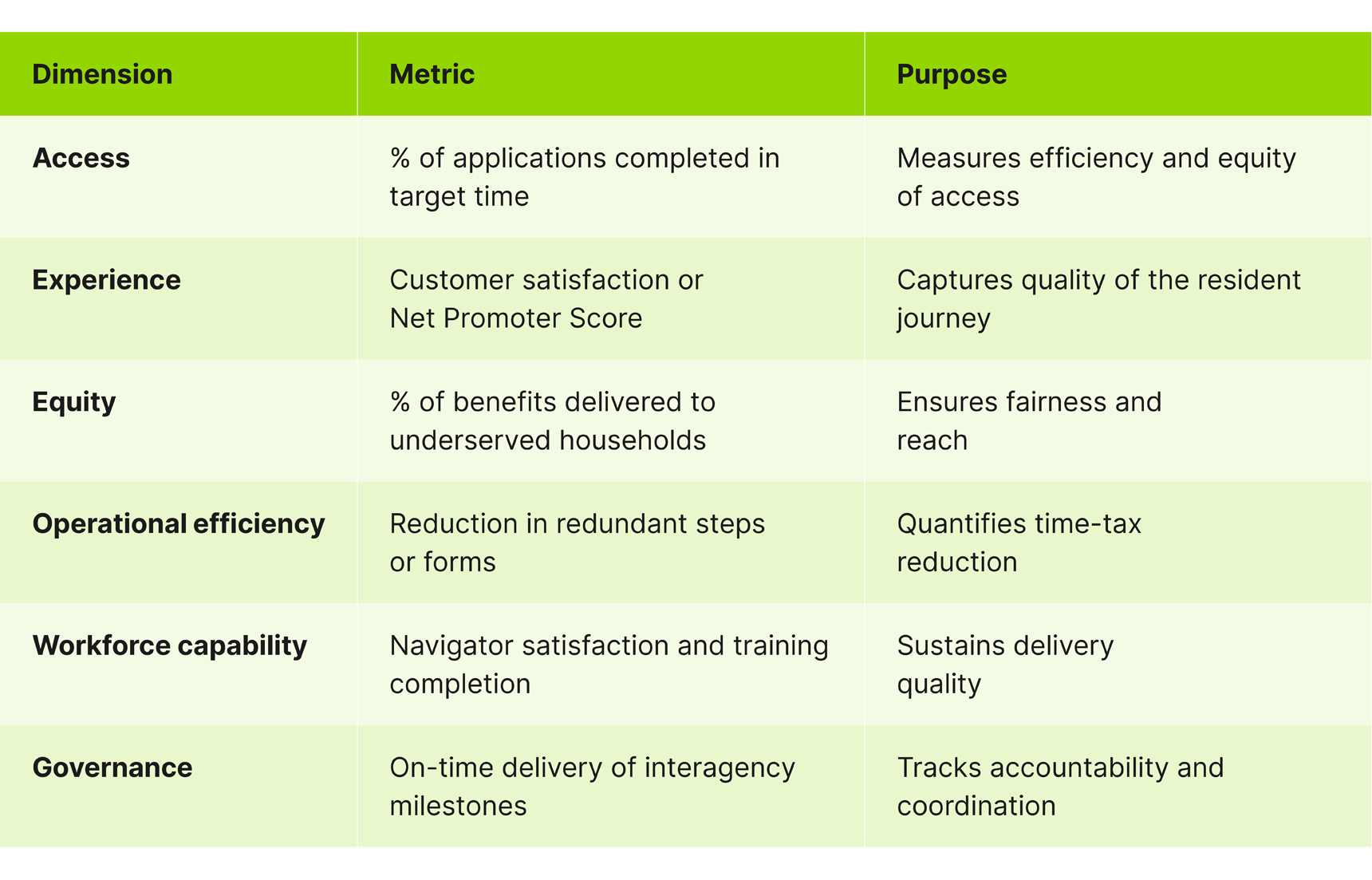
Successful teams also work through conflicts in program requirements early and coordinate how they stack and braid funding to match each household’s needs. Perhaps most important, teams running successful programs begin data-sharing discussions early, knowing that even agencies with shared goals often struggle to achieve interoperability. All of this means early and frequent coordination with agency legal staff and ensuring they understand the overall programmatic goals (in addition to the legal requirements).
These operational and management habits are what turn vision into results. With success factors baked in from the start, leadership teams can ensure that their one-stop shop stays agile and accountable as it grows.
Scaling a one-stop shop requires a clear program model. When designing one, it can be helpful to look at what other states are already doing. In Michigan, the Department of Environment, Great Lakes and Energy (EGLE) partnered with the Department of Health and Human Services (MDHHS) to streamline income verification for its Home Energy Rebate program (MiHER). By aligning its home energy initiative with the state’s largest public assistance programs, Michigan created a unified categorical eligibility process.
Stakeholder engagement is another way to build capacity. For example, Georgia has conducted extensive community outreach for its home energy rebate program in order to raise awareness and inform consumers about the options available to them.
These examples show how inter‑agency collaboration can reduce redundancy, simplify enrollment, and provide a single front door for households. It also demonstrates how a one‑stop shop moves from concept to delivery: by starting with a clear customer profile to identify needed functionality, integrating eligibility processes across agencies, and providing training to key stakeholders in order to translate a shared vision into a seamless customer experience.
A true one-stop shop is more than a portal. It is an operating model that unites agencies, contractors, and communities around a single mission: delivering a frictionless experience and ensuring that residents act on the benefits they’re eligible for.
The most successful programs build feedback loops into their design, measure what matters, and adapt based on customer insights. With the right governance, data integration, and workforce readiness efforts, states can transform complexity into clarity. Doing so makes for satisfied customers and redefines what effective government service delivery looks like.
For state energy initiatives, success will depend on disciplined operations, strong interagency trust, and partners who can deliver. A single front door, supported by aligned operations and smart program management, empowers states to make home energy upgrades simpler, faster, and fairer for everyone.

Raquel Malmberg, Partner
Guidehouse is a global AI-led professional services firm delivering advisory, technology, and managed services to the commercial and government sectors. With an integrated business technology approach, Guidehouse drives efficiency and resilience in the healthcare, financial services, energy, infrastructure, and national security markets.