




.jpg?la=en&h=170&w=310&hash=1B44A4619EFA8E406DA32569632545B3)

 Deutschland
 India
India Lietuva
 United Kingdom
 Search
 Search



Scaling up clean technologies to help achieve carbon neutrality and climate resilience requires significant capital. Around the world, substantial funding is theoretically available. This could come from multilateral development banks, development finance institutions, or multilateral funds (funding pools provided by multiple countries or governments, such as the Green Climate Fund or the Global Environment Facility). For more mature sectors, it’s also common to raise finance from commercial banks, institutional investors, and private capital markets.
But for the moment, investors for major decarbonisation projects remain scarce. This isn’t surprising, as investors must understand a project’s risk profile to make capital funding available. Investors hate risk—and in a sector with inconsistent or disjointed regulatory requirements, geopolitical uncertainty, uncertain carbon revenues, and a wealth of innovative but unpredictable pilot projects, analysis-resistant risks abound. Green policies are subject to change. Unproven technologies may not work as expected. Local marketing or banking systems may be immature. And new or poorly developed projects offer unclear returns.
Two approaches can help bring decarbonisation project risks under control. Although separate, they’re complementary as each reinforces the effectiveness of the other.
The first approach requires governments to establish stable policies, pricing systems, and incentives, giving investors a better idea of the returns they can expect. The following table shows examples of this approach.

One example of this is the Cool Up programme, which promotes sustainable cooling in Egypt, Jordan, Lebanon, and Türkiye to build confidence among public and private sector stakeholders. Financed by Germany’s International Climate Initiative and implemented by Guidehouse, the programme takes a comprehensive approach to establishing stable conditions for scaling sustainable cooling solutions. It combines policy advice, capacity building, and market development to address current fragmented regulatory frameworks and market immaturity while strengthening institutional capacities. Pilot projects to date showcase the technical and financial viability of high-efficiency, climate-friendly cooling technologies in real-world settings (such as CO2-based public sector refrigeration installations in Jordan).
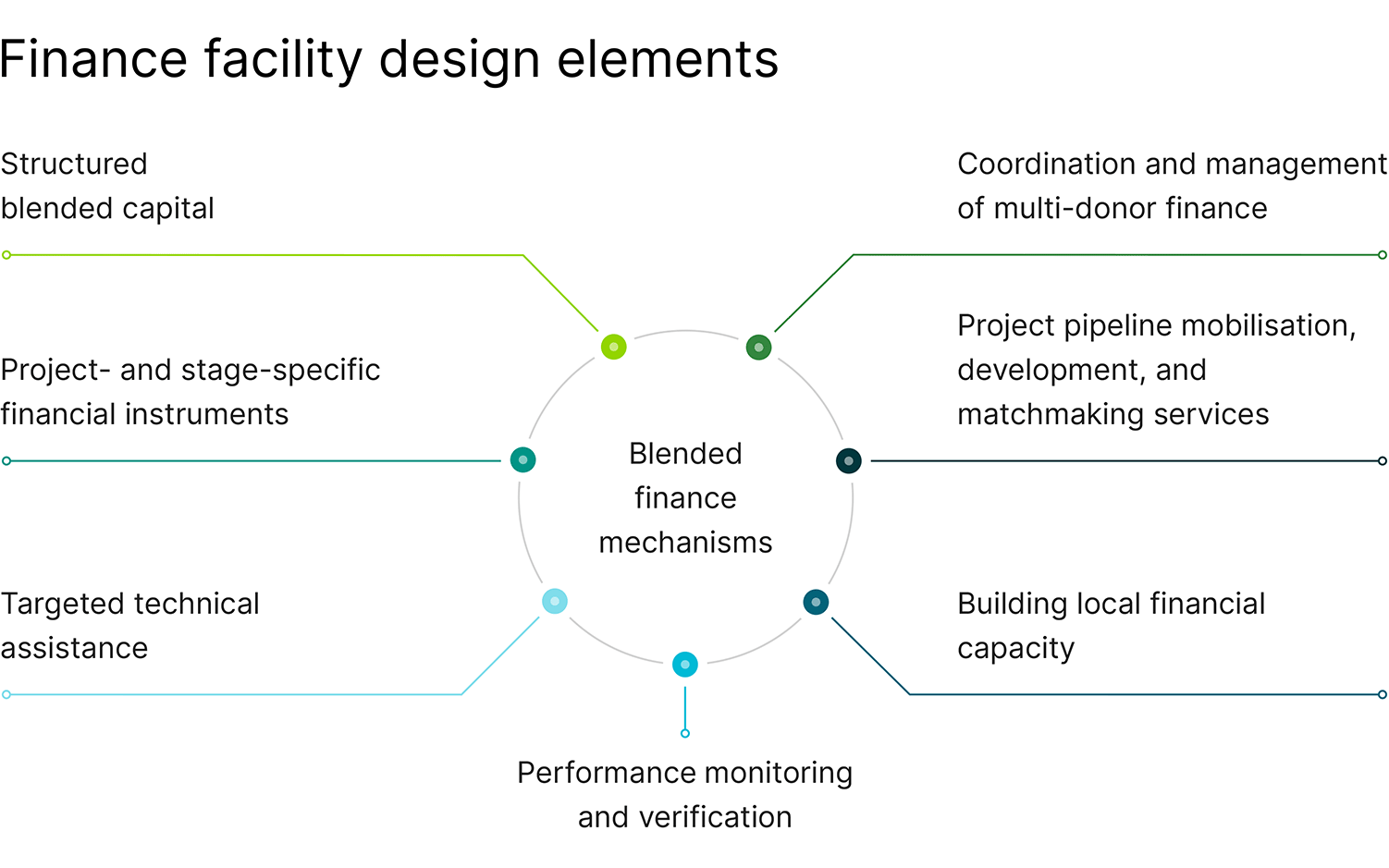
Sector-specific finance facilities that blend public and private resources represent the second approach to scaling innovative climate investment. These blended programmes use concessional, risk-tolerant capital from public or philanthropic sources to de-risk early-stage projects, making them more attractive to private investors.
Finance facilities deliver funds more efficiently by using a variety of funding instruments based on project requirements and more streamlined processes for smaller projects. They often include technical assistance as well and feature delivery models that vary by geography, sectoral scope, source, amount, and type of funds.
A number of countries and regions have established these finance facilities to address sector-specific barriers to investment. Examples include:
Blended finance facilities can de-risk major decarbonisation projects by:
Spotlight: The Türkiye Industrial Decarbonisation Investment Platform
The Türkiye Industrial Decarbonisation Investment Platform is a government-led coordination platform under the leadership of the Ministry of Industry and Technology in close collaboration with the Ministry of Treasury and Finance. TIDIP was established through the Joint Declaration signed by the Ministry of Industry and Technology of the Republic of Türkiye, the European Bank for Reconstruction and Development (EBRD), the International Bank for Reconstruction and Development (IBRD) and the International Finance Corporation (IFC). The Platform facilitates coordinated action among public institutions, industry, development partners, and finance around shared industrial decarbonisation priorities.
TIDIP aims to support the development of a credible, investment-ready pipeline and strengthen the enabling environment for low-carbon industrial investment in Türkiye by:
The Platform’s initial focus is on energy-intensive industries such as steel, aluminium, cement, and fertilisers, with planned expansion to sectors such as glass, ceramics, and chemicals.
If the public and private sectors work together now to blend capital and channel it efficiently in major industrial decarbonisation projects, they can help establish the foundation for commercially and economically self-sustaining decarbonisation efforts. Providing a stable, more predictable risk environment could unlock investment, build market confidence, and create the conditions for long-term commercial viability. This would be a vital step on the path to large-scale decarbonisation, net zero target success, and long-term climate resilience.

Daniel Becker, Partner, Europe, Middle East & Canada
Katja Eisbrenner, Partner, Europe, Middle East & Canada
Guidehouse is a global AI-led professional services firm delivering advisory, technology, and managed services to the commercial and government sectors. With an integrated business technology approach, Guidehouse drives efficiency and resilience in the healthcare, financial services, energy, infrastructure, and national security markets.