




 Deutschland
 India
India Lietuva
 United Kingdom
 Search
 Search



“Green gases” such as biogas and biomethane can be made from renewable, often waste-based feedstocks such as manure, agricultural residues, and organic waste. This means that they turn former disposal problems into useful, sustainable energy.
The European Union (EU) faces the challenge of reaching its net zero greenhouse gas emissions target by 2050 while addressing energy security concerns. Recent supply shocks have made it clear that Europe’s dependence on imported fossil gas is a vulnerability. The European Commission policy frameworks REPowerEU and AccelerateEU were designed to target energy independence by phasing out Russian fossil fuels, protecting consumers from price shocks, and accelerating the green transition.
Green gases have a significant role to play in achieving those goals—especially because the science is clear. Injecting biomethane into existing gas grids using Europe’s extensive infrastructure can partially displace imported fossil gas and reduce emissions. And biogas produces a by-product called digestate that can be used as a nutrient-rich fertiliser, reducing water and air pollution compared with synthetic alternatives.
As described in the 2026 Fertiliser Action Plan, the EU aims to shift to domestically produced, bio-based, low-carbon, circular fertilisers. In addition to the resulting environmental benefits, using domestically produced fertiliser will further decrease Europe’s import dependency and improve food security.
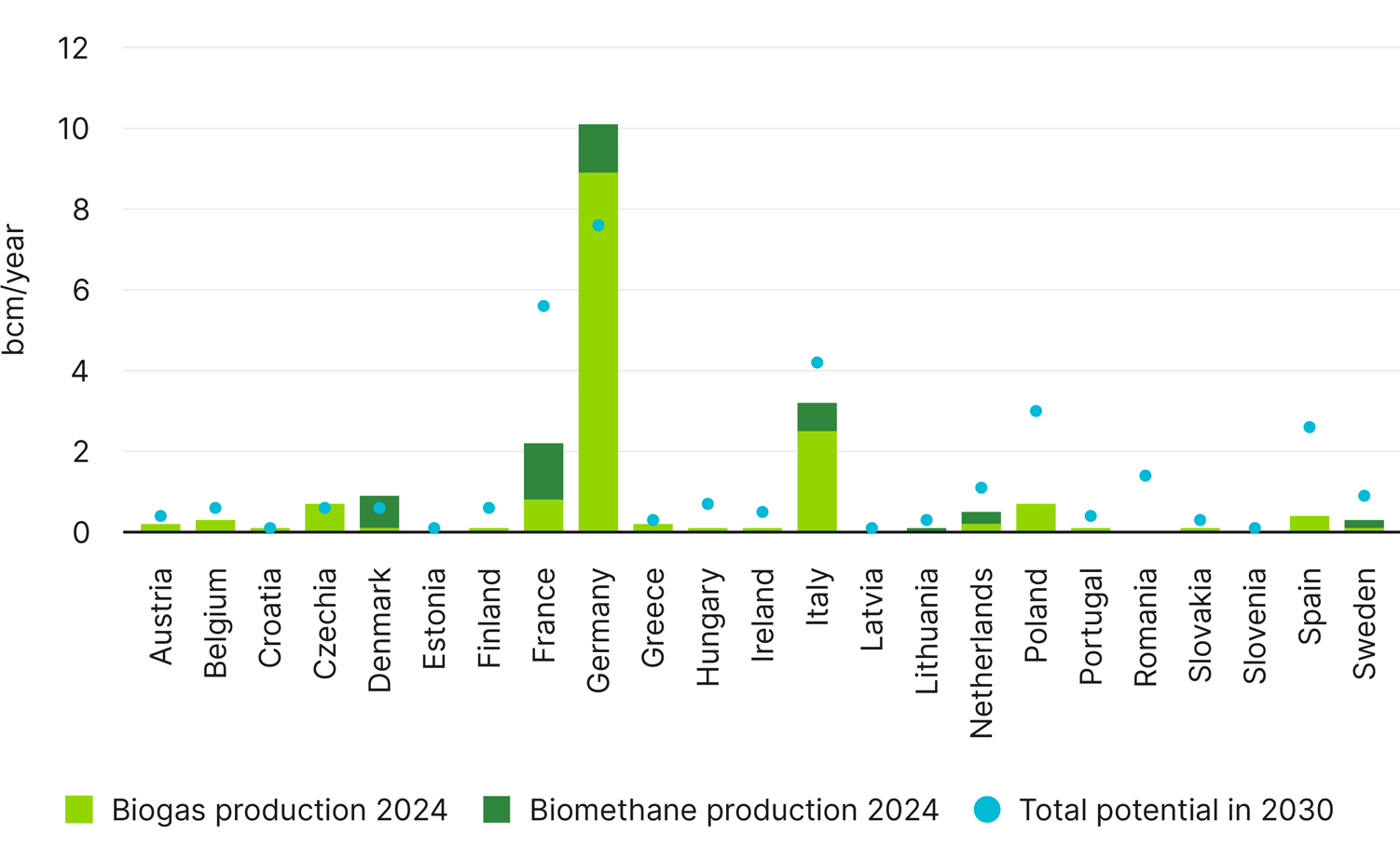
European leaders want to scale fast. RePowerEU is targeting EU biomethane production levels of 35 billion cubic metres (bcm) by 2030. To put this in context, in 2024 the EU produced about 5 bcm of grid-quality biomethane and 17 bcm of biogas.
Scaling up from where things stand today won’t be straightforward. Many EU countries lack the minimum requirements for a green gas supply chain, including project pipelines, equipment, skilled operators, upgrading and grid-connection capacity, and reliable buyers. The region will need stable policy support, clear standards, and predictable permitting to reduce risk and unlock investment where sustainable feedstocks are available.
Current green gas production vs. potential biomethane production by 2030
Source: European Biogas Association
While there’s potential to scale green gas production in Europe, the amounts that can ultimately be produced are limited. The binding constraint is how much sustainable feedstock can be mobilised without creating new land use or environmental pressures.
Earlier this year Guidehouse published a study for the EBA assessing Europe’s potential for domestic biomethane production. It shows that by 2030, domestic potential could be around 34-35 bcm, mostly through anaerobic digestion using wastes, residues, and sequential cropping. In the near term, this potential is concentrated across a handful of countries, with the largest being in Germany, France, Italy, Poland, and the UK.
Looking to 2050, domestic potential estimates span a wider range of 181-205 bcm. Achieving the high end of these estimates will require proactive growth of sustainable crops on underutilised, degraded land as well as effective technology roll-outs, investments, and permitting. Sustainable feedstock and conversion pathways will also need to scale accordingly.
A recent Guidehouse article on industrial decarbonisation shows that while technical pathways are available, unlocking the potential for green gas production still faces barriers. Cost is a key factor as leaders must consider how much biomethane reduces emissions compared with the next best option, such as electrification, efficiency, hydrogen, or other biofuels. In several applications, especially high-temperature heat decarbonisation and flexible peak energy, biomethane could be among the cheapest alternatives.
These domestic supply limitations mean that leaders must choose which end uses to prioritise. A 2025 Guidehouse study for the Dutch Ministry of Climate and Green Growth on green gas long-term production and use estimated future supply and demand levels along with the incremental costs or savings associated with different use cases.
An illustration from that study shows that green gas usage across the spectrum can increase costs or face practical constraints, underscoring the need to tailor it to specific use cases. For example, using green gases for peak electricity, peak district heating, and select industrial processes such as ceramics can deliver meaningful CO₂ reductions at relatively low cost as measured by tonnes of CO₂ avoided. But paper production, road transport, and methanol production have more cost-effective alternatives.
Higher/lower costs of green gas

Source: Guidehouse (Dutch language)
It’s important to note that these rankings are based on societal costs that are specific to the Dutch setting. Prioritising use across Europe must take into account infrastructure considerations, negative emissions, end-user decisions, and lock-in effects such as long-term policy, financial, or infrastructural commitments to gas-dependent systems. Leaders must also consider non-energy carbon uses following the cascading principle, where bio-based carbon such as wood or biomass is used for material applications and products first, followed by reuse and recycling methods—leaving direct combustion for energy as the last option.
Green gases will never completely replace fossil fuels, but they can play an important role in Europe’s renewables mix—especially in areas or sectors where electrification is challenging or where domestic green gas supply strengthens energy security. With limited volumes, the goal is simple: encourage production wherever it’s sustainable and use it where it delivers the most benefit.

Michèle Koper, Director
Guidehouse is a global AI-led professional services firm delivering advisory, technology, and managed services to the commercial and government sectors. With an integrated business technology approach, Guidehouse drives efficiency and resilience in the healthcare, financial services, energy, infrastructure, and national security markets.