




.jpg?la=en&h=170&w=310&hash=1B44A4619EFA8E406DA32569632545B3)

 Deutschland
 India
India Lietuva
 United Kingdom
 Search
 Search


As mortgage organizations accelerate digital transformation efforts, their ability to manage and exchange data consistently has become a strategic priority. Industry standards such as those set by MISMO—a Mortgage Bankers Association nonprofit subsidiary that creates data standards for the U.S. mortgage industry—provide a common foundation for interoperability, automation, regulatory reporting, and emerging AI-enabled capabilities.
The mortgage and housing finance industry faces sustained pressure to reduce operating costs, improve data integrity, accelerate cycle times, and strengthen compliance oversight. Legacy systems and fragmented data models continue to limit the return on modernization investments. As a result, the business case for modernization has become increasingly urgent.
Freddie Mac reports that loan origination costs have increased 35% over the past three years at approximately $3,000 per loan, while the average retail lender has lost about $600 per loan. These economics are driving lenders to prioritize automation, interoperability, and standardized data to improve operational efficiency.
Organizational leaders who view MISMO as core enterprise infrastructure instead of a narrow compliance obligation can reduce manual reconciliation, simplify vendor integration, improve data lineage, and establish a stronger foundation for digital mortgage and AI-enabled capabilities. Organizations that delay adoption face risks such as continued exception processing, higher integration debt, and weaker readiness for regulator, investor, and counterparty expectations.
AI and automation require clean, structured data. Models built on inconsistent loan, document, servicing, or counterparty data create greater model risk, weaker automation outcomes, and more complex governance reviews.
Borrowers expect a digital mortgage experience. Federal Housing Finance Agency and Consumer Financial Protection Bureau survey data show rising borrower demand for digital mortgage capabilities. Nearly half of borrowers report that a paperless, online mortgage process is important, reinforcing the need for standardized data and interoperable systems that can support faster, more seamless borrower experiences.
Digital mortgage adoption depends on interoperability. SMART Doc, eMortgage, eVault, remote online notarization, and servicing transfers all require common data definitions and repeatable exchange formats to enable efficient information-sharing across market participants.
Compliance expectations continue to rise. Regulators, investors, and government-sponsored enterprises increasingly expect organizations to demonstrate data quality, ownership, lineage, controls, and repeatable reporting across the loan lifecycle.
Mortgage transformation depends on robust data standards such as those developed by MISMO. These standards provide the foundation that enables consistent, scalable processes across the mortgage lifecycle. Without them, even advanced technologies struggle to deliver consistent, scalable results.
By investing in MISMO standard adoption, mortgage companies can establish a foundation for efficient operations, seamless data exchange, and innovation. Organizations that adopt MISMO standards realize benefits across operations, compliance, and strategic positioning, including:
The result is a stronger modernization foundation. Benefits include fewer data translation errors, more consistent investor and regulatory submissions, and greater confidence in downstream analytics.
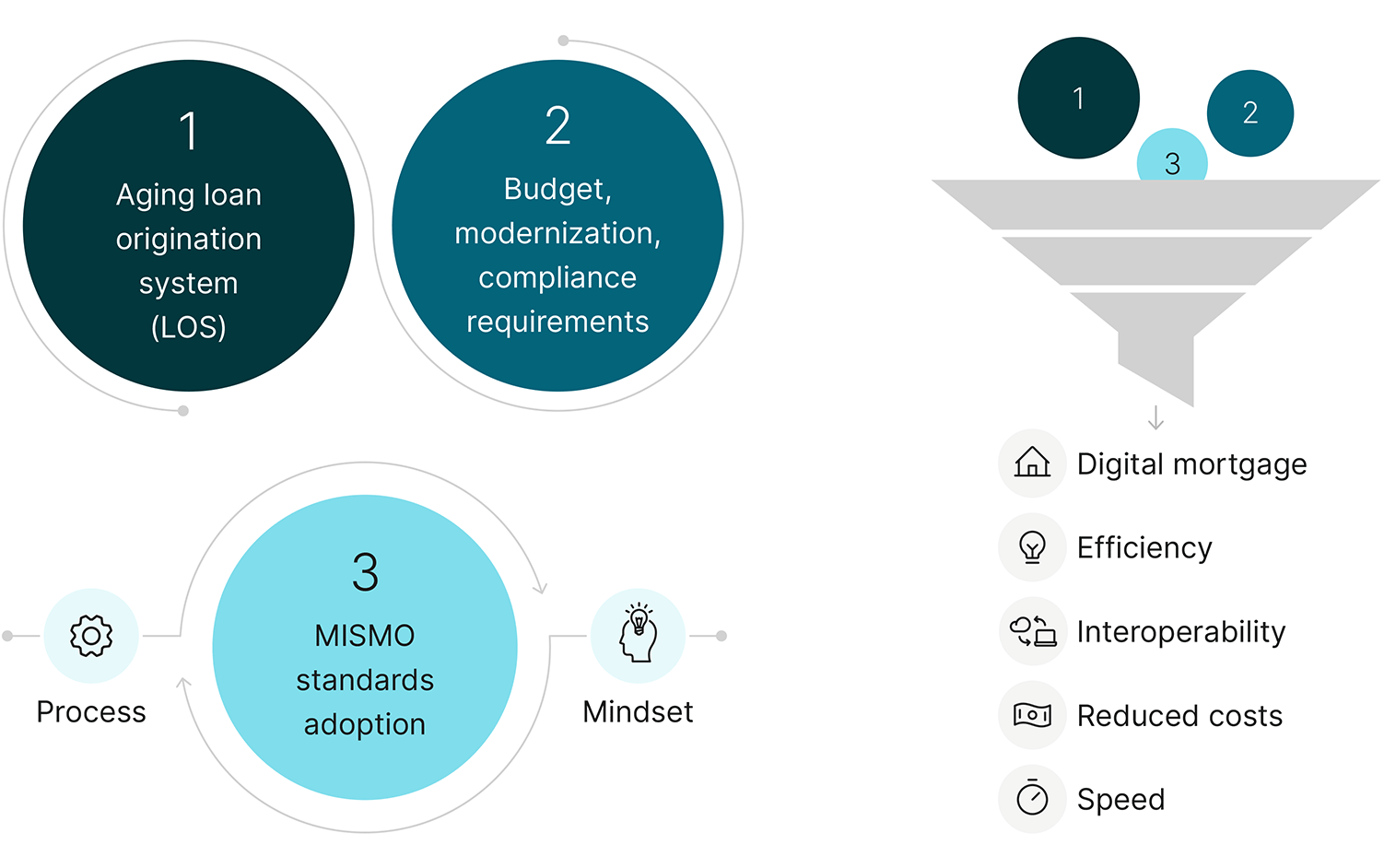
A successful MISMO adoption program should be phased, governed, and aligned to measurable business outcomes. The goal is not to convert every system at once, but to prioritize the exchanges and data domains that create the greatest operational, compliance, and modernization value. Organizations that take a structured approach can accelerate adoption while minimizing disruption and creating a sustainable foundation for future growth.

MISMO standards make data portable, consistent, and machine-readable. That foundation is essential for responsible AI because automation, analytics, document intelligence, fraud screening, and servicing recommendations depend on consistent inputs and clear data lineage.
MISMO’s Framework for Responsible AI in Mortgage Ecosystems (FRAME) extends this value by giving organizations a practical governance layer for AI adoption. It helps them identify AI use cases, apply risk-tiered oversight, assign accountability, and document controls. It also connects AI review to model risk, compliance, vendor oversight, cybersecurity, and data governance processes.
Together, MISMO standards and FRAME support modernization on two fronts: the data structure needed to scale digital workflows and the governance discipline needed to make AI-enabled capabilities auditable, explainable, and defensible.
The next step is turning standards from a technical requirement into a practical modernization reality by:
MISMO adoption is becoming a strategic imperative for mortgage organizations seeking to modernize operations, strengthen compliance, and participate fully in the digital mortgage ecosystem. Those that invest in standards-based data can reduce friction across the loan lifecycle, improve confidence in analytics, and establish a scalable foundation for automation, interoperability, and AI.
As digital mortgage adoption continues to evolve, standardized data will play an increasingly important role in enabling operational efficiency, regulatory readiness, and innovation across the mortgage industry.
Guidehouse is a global AI-led professional services firm delivering advisory, technology, and managed services to the commercial and government sectors. With an integrated business technology approach, Guidehouse drives efficiency and resilience in the healthcare, financial services, energy, infrastructure, and national security markets.