




 Deutschland
 India
India Lietuva
 United Kingdom
 Search
 Search



What makes an orchestra great is the sum of its parts. A soloist may sound strong on their own, but a full symphony delivers an unmistakenly powerful experience.
The same is true of the electronic health record (EHR). Organizations can upgrade individual features to improve functionality and help staff work more efficiently, but the greatest value comes from identifying and coordinating the right set of enhancements and data integrations to advance organizational goals.
We refer to this holistic approach as “EHR orchestration”—something that’s becoming a critical competency for healthcare organizations as they deploy AI solutions that leverage data across the technical ecosystem to inform the EHR’s most effective clinical and administrative actions.
The EHR has always been a foundational system. From the moment healthcare organizations shifted from paper to digital, they’ve steadily added features and enhancements, investing significant time, resources, and vendor partnerships along the way. Over time, “EHR optimization” has become a defining capability for both healthcare organizations and their technology partners.
The introduction of AI has positioned the EHR as a holistic platform that accelerates and enables experiences and outcomes for healthcare organizations. This orchestration role represents a shift from prior EHR optimization work, in which improvements were sequenced as individual features. With AI, providers can unlock the interconnectedness of EHR data in new ways and advance organizational goals.
Taking the musical metaphor a step further: Sophisticated IT leaders are thinking intently about the composition of technical solutions within the EHR and beyond as they seek to solve multiple problems through comprehensive, multi-faceted improvements. They’re aligning all parts of their IT strategy to ensure that they’re playing the same notes, on the same page, and at the same tempo.
AI will accelerate this shift. Rather than waiting for APIs and integrations to be developed natively, healthcare organizations will be able to stitch together disparate systems more quickly. The EHR no longer needs to be the center of everything. AI will allow both patients and providers to experience the EHR more holistically by orchestrating processes across fragmented systems and generating content from varied data sources. But this core system still needs to be configured to support this future.
One of the key areas Guidehouse is focusing its EHR orchestration efforts on is population health, because so many different data sources, applications, and organizations contribute to population health management.
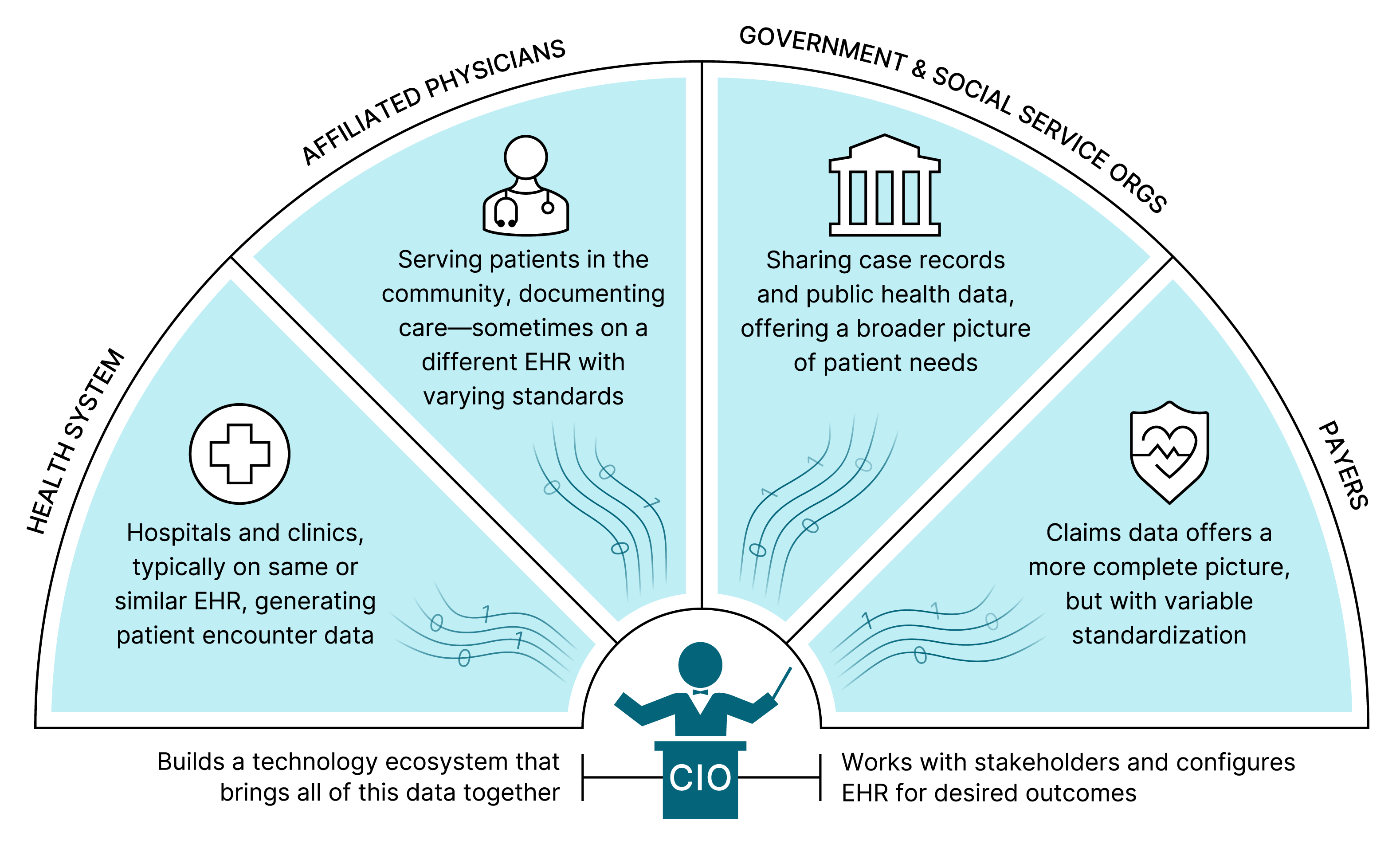
Viewed through the orchestra analogy, a health system is the strings section—the core of the ensemble—with its hospitals and employed physicians typically operating on the same EHR and typically. Affiliated physicians—the smaller, yet still important brass section—generate care documentation but may be using other systems with varying data standards. Payers—the woodwinds—also contribute to this effort with claims data, which may not be shared consistently or in a standardized form. Social service organizations and state and local health agencies—the percussion section—contribute case management records and public health data, which is different in nature from medical records but vital to fully evaluating population health needs and outcomes.
AI can synthesize data from all of these sources—the “notes” they each play—and generate meaningful insights for our audience: the patients, providers, and staff who use this data. But our conductor, the CIO, needs to build a technology ecosystem that brings all of this data together in a clean, accessible way, allowing AI to drive insights and actions within the EHR.
To do that, the CIO must work with each instrument separately, aligning EHR features and managing the flow of data to achieve the outcomes they want—the “music” we hear from the full ensemble.
Diagnostics data offers a clear example. Lab results are a critical data point for population health but translating them into actionable insights requires a tightly coordinated set of processes. The right physician must be able to place the appropriate order, which has to reach the lab accurately. The lab must be able to perform the test or route it externally when needed, and the correct charge must be applied. Configuring all of these steps correctly within the EHR often requires substantial manual review, front-end configuration, and ongoing maintenance—particularly for tests that aren’t performed in-house. And this is just one microcosm of the many processes that originate in the EHR.
AI can resolve minor data inconsistencies, but the EHR and other core systems must be configured correctly to provide AI engines with complete, reliable data.
While the healthcare industry’s use of AI is still in its infancy, your organization can take the following concrete steps now to future-proof your core systems.
Shift to an experience-state IT strategy. Healthcare organizations have long focused their IT strategies on technology aspirations rather than solving for clinical or operational challenges. Systems have traditionally centered their IT strategies on technology goals—reducing clicks, refining interfaces, and building integrations. AI changes that dynamic as agents gather data from across platforms in a unified, conversational way. To capitalize on that, you should start with the business and population health challenges you’re trying to solve for and design the technology strategy that supports your desired outcomes.
Design for openness—with regulation in mind. Litigation is pending, and questions remain about how EHR data will flow to external applications, including AI platforms. Even so, some EHR vendors are embracing interoperability. Instead of waiting for the details to be resolved, you should make calculated decisions and begin building a framework that supports secure, seamless movement of data into and out of the EHR—regardless of what level of openness is ultimately required.
Engage your EHR vendor and system integrators. Now is the right time to collaborate with EHR vendors and any partners that support your core system strategy. Their expertise can help develop a practical roadmap for enabling effective AI implementation aligned with your organization’s strategic priorities.
Providers that strengthen their EHR data, capabilities, and governance today will be well-positioned to adopt advanced AI capabilities as the technology evolves and expectations rise.

Hannah Ellerbee, Partner
Mallory Powers, Director
Guidehouse is a global AI-led professional services firm delivering advisory, technology, and managed services to the commercial and government sectors. With an integrated business technology approach, Guidehouse drives efficiency and resilience in the healthcare, financial services, energy, infrastructure, and national security markets.