




.jpg?la=en&h=170&w=310&hash=1B44A4619EFA8E406DA32569632545B3)

 Deutschland
 India
India Lietuva
 United Kingdom
 Search
 Search



Today’s primary care landscape is shaped by intensifying internal and external pressures that are straining traditional care delivery models.
In many health systems, operational workflows are constraining access, eroding the patient experience, and exacerbating provider burnout. Clinicians are expected to manage highly variable patient needs and increasing administrative requirements within rigid appointment schedules while still maintaining patient throughput and delivering personalized, high-quality care. The result is ongoing provider pressure and a practice environment that’s increasingly difficult to sustain.
At the same time, escalating rates of chronic disease and behavioral health conditions are increasing clinical complexity even as healthcare consumers demand greater convenience, virtual access, and personalized care. Health systems are also facing mounting pressure from both traditional competitors and market disruptors such as retail clinics, digital health platforms, and private equity-backed providers. These players are actively carving out patient segments and creating new profit pools across the acuity spectrum, capturing value at multiple points along the industry value chain.
These pressures come at a time when more and more health systems are depending on primary care to serve as an enterprise growth engine—not only as the front door to the care continuum but also as a strategic platform for clinical risk management and long-term value creation. Primary care is expected to attract and retain patients, coordinate whole-person care across clinical, behavioral, and social needs, and anchor patients within the care network to reduce leakage. It must do all of this while maintaining a strong provider workforce and enabling sustainable productivity and manageable workloads.
Primary care’s traditional one-size-fits-all model fails to reflect the variability in patients’ clinical complexity, social needs, and care preferences, treating scheduling and care delivery as though all patients are the same. This results in mismatched visit lengths, longer wait times, inadequate clinic resourcing, reduced access and outcomes, and ultimately, growing provider frustration.
To thrive, primary care leaders must adopt differentiated strategies that meet the diverse needs of today’s patients. This requires designing care pathways around patients’ whole-health needs and segmenting populations based on clinical risk, social determinants of health, and patient care preferences—including their desired care modalities across virtual, hybrid, and in-person settings. Grounded in these drivers, providers will be able to provide more personalized, effective care that builds patient loyalty, drives operational efficiency, and promotes sustainable growth.
As a strategic framework for reimagining primary care, patient segmentation helps health systems to move beyond standardized visit lengths and limited clinical support that treat patients as operationally equivalent. Provider organizations that recognize meaningful differences in care complexity, resource utilization patterns, and patient preferences can enable more effective, proactive, targeted care delivery.
No single segmentation model can apply universally because each market has distinct demographic, socioeconomic, and healthcare characteristics, and each patient brings different clinical, behavioral, and social needs. The number and types of patient segments should be defined by the market, reflecting the unique needs, preferences, and utilization patterns of the population served.
For example, a young professional in a major metropolitan market (patient A) may prefer efficient, technology-based care modalities, while a retiree in a more suburban setting (patient C) may require longer in-person visits with their provider and dedicated support from adjacent clinical team members such as pharmacy and social work. And a working parent with newly diagnosed chronic conditions (patient B) may value a hybrid option that blends both modalities.
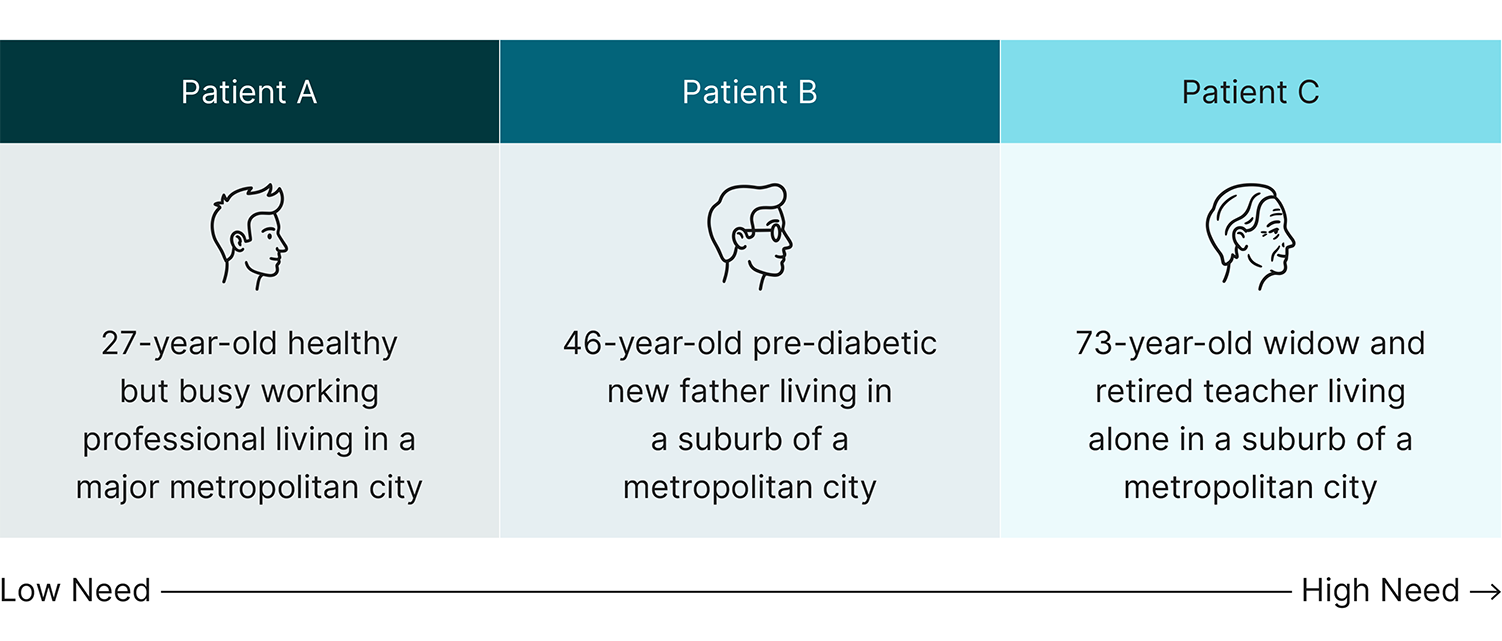
Once patient populations are properly segmented, health systems can intentionally design care models and clinics around the distinct needs of each patient segment.
Segmentation supports differentiated approaches to visit duration and cadence, with longer, more frequent visits for high-complexity patients and shorter, less frequent visits for those focused on wellness maintenance and preventative care. It also informs care team design, helping health systems deploy the right mix of physicians, nurses, medical assistants, advanced practice providers, and other clinical and support staff based on patient complexity.
For example, clinics serving older patients with multiple chronic conditions may need a team-based, longitudinal model with longer appointments and care management support. Clinics serving younger, healthier patients may be better suited to a convenience-focused model with virtual visits, on-demand access, preventive care, and urgent care.
Access models can be tailored as well, with virtual-first pathways serving convenience-oriented populations, and blended or high-touch in-person models providing more comprehensive support for patients with greater clinical or social needs. Beyond access and staffing, segmentation enables more targeted care management, including proactive chronic disease management, integrated behavioral health support, and structured interventions to address social drivers of health.
By aligning intensity and resources with patient needs, health systems can improve clinical outcomes and patient experience while enabling care teams to practice at the top of their license. This will help reduce cognitive burden, improve workflow predictability, and mitigate burnout to create a primary care environment that’s both clinically effective and professionally sustainable.
Healthcare leaders must take a data-driven approach to align patient experience, care delivery, and provider capacity with the distinct needs of the populations they serve. By segmenting patients and designing clinic operations around those segments, leaders can improve access and loyalty, attract and retain patients, and create a more sustainable practice environment for physicians and care teams.
Now is the time to move beyond uniform care delivery models and toward a future in which primary care is personalized, data-driven, and designed around the full complexity of human health.
Guidehouse is a global AI-led professional services firm delivering advisory, technology, and managed services to the commercial and government sectors. With an integrated business technology approach, Guidehouse drives efficiency and resilience in the healthcare, financial services, energy, infrastructure, and national security markets.