




.jpg?la=en&h=170&w=310&hash=1B44A4619EFA8E406DA32569632545B3)

 Deutschland
 India
India Lietuva
 United Kingdom
 Search
 Search



This article is the sixth in a series about how energy providers can thrive in an AI-powered future.
The electric grid is entering a phase in which its primary limitation isn’t just capacity or digitization but also decision-making speed and precision. As variable resources, volatile weather, and large loads converge on the system, utilities are being asked to make increasingly complex tradeoffs—often in minutes or even seconds. The grid’s next evolution isn’t simply smarter hardware or more data. It’s the ability to sense conditions, reason across them, and act continuously.
In this AI-enabled “cognitive grid,” intelligence becomes the organizing force. Rather than optimizing assets in isolation, the system coordinates traditional infrastructure, distributed energy resources (DERs), customer behavior, and large loads as parts of a single operating fabric. This coordination allows utilities to extract more value from what already exists, operating the grid as a unified system with awareness of risk, flexibility, and constraints.
Conventional operating models—built on static assumptions, predefined thresholds, and episodic decisions—weren’t designed for today's level of volatility and complexity. The challenge isn’t a shortage of intelligence at the asset level. It’s the absence of a systemwide decision framework that can connect signals, anticipate outcomes, and adapt in real time—linking grid-edge devices, DERs, core infrastructure, and flexible demand into a continuous loop of sensing, reasoning, and action. That’s the promise of the cognitive grid: infrastructure that doesn’t just move power but also understands the system it operates in and responds accordingly.
A cognitive grid goes beyond traditional analytics. Rather than serving a specific function in a specific operational silo, it’s defined by how decisions are made across the enterprise through four core capabilities:
Sensing: The cognitive grid draws from a wide, growing set of signals, including advanced metering infrastructure (AMI) 2.0, grid-edge devices, line sensors, phasor measurement units, inverter telemetry, asset condition data, weather forecasts, and large load operational signals (where available).
Reasoning: AI evaluates tradeoffs across reliability, cost, and capacity constraints in near-real time. Instead of relying on static thresholds or worst-case assumptions, it enables probabilistic, scenario-based reasoning across both supply and demand.
Acting: Insights translate into coordinated action: switching and protection adjustments, utility-scale generation, DER and energy storage dispatch, demand shaping, and targeted customer communication. Actions are sequenced and localized rather than blunt and systemwide.
Learning: Outcomes feed back into the system, becoming inputs for future decisions based on what worked, what didn’t, and why.
When it comes to the electric grid, “cognitive” in this usage doesn’t mean purely autonomous. Human operators remain accountable for outcomes, but AI augments their judgment by making complexity manageable across the entire business. That helps compress decision timelines, uncover potential unintended consequences, and reveal options that would otherwise remain unrecognized.
DERs are often framed as an integration challenge. In practice, they’re becoming one of the grid’s most valuable operational assets. In a cognitive grid, DERs are continuously monitored, expected behavior is understood, and flexibility can be accessed when system conditions require it. The value is practical and immediate. Overloaded feeders can be relieved without emergency switching, voltage issues can be addressed locally, and customer-owned resources can help absorb stress before outages occur.
For utilities, this means fewer customer interruptions and lower operating risk. For customers, it means fewer disruptions and more predictable service. When intelligence is applied, DERs stop being edge complexity and start functioning as core system flexibility.
In a similar vein, AMI 2.0 is often discussed in terms of billing or customer programs—but in a cognitive grid, its role is far more consequential. Where AMI 1.0 delivered interval data, AMI 2.0 delivers situational awareness. When combined with AI, grid-edge data reveals where stress is emerging, how customers and DERs are responding to conditions, and whether system models align with conditions on the ground.
This intelligence supports operations, customer interaction, and planning. Operators gain earlier warnings of localized issues. Customer teams can communicate proactively and credibly during events. Planners get feedback on how assets and customers behave under stress.
The true value of AMI is not in the meter itself but in its integration with other systems. Grid-edge intelligence closes the loop between planning assumptions and operational reality.
Large new loads—particularly those related to data centers—are often discussed as threats to grid reliability and affordability. But that framing is incomplete.
Traditional operations treat large loads as binary: either on or off, connected or absent. But many large customers can offer (and benefit from) meaningful flexibility. Compute workloads can be shifted or throttled during peak periods, while onsite generation and storage can provide grid support. Load ramps can be managed within clearly defined operational limits.
In a cognitive grid, AI allows utilities to model large loads probabilistically, identify when flexibility is available, and coordinate that flexibility alongside DERs and storage. Large loads don’t replace other resources; they become one component of a broader flexibility portfolio.
Demand becomes a controllable variable instead of a fixed constraint, providing utilities with options. Incentives can help increase participation in flexibility programs. Participating large loads can reduce peak strain, defer or eliminate unnecessary capital upgrades by unlocking underutilized capacity, support resilience strategies, improve overall system efficiency, and create economic benefits. It’s a win-win for customers and utilities alike.
The economic, safety-related, and reputational costs of outages are rising just as affordability pressures and storm and wildfire threats are intensifying. Traditional self-healing approaches built on predefined logic and limited context work well for known failure modes but struggle in a grid defined by volatility and disparate distributed resources.
Cognitive grids change the equation by making reliability and resilience adaptive and anticipatory. AI continuously synthesizes weather forecasts, asset health, DER behavior, and load patterns to identify stress before failure occurs. As conditions deteriorate, the system can coordinate network reconfiguration, targeted DER dispatch, and selective load shaping to localize impacts and prevent cascades. Before major events, AI identifies opportunities to pre‑position storage and distributed resources and highlights circuits where flexibility will matter most. During events, it reassesses risk in real time, adjusting actions as conditions evolve rather than relying just on fixed plans.
The result is not just faster restoration but fewer customer minutes interrupted in the first place. Coordinated use of DERs and large customer resources reduces reliance on blunt systemwide actions such as widespread shutoffs while preserving service to critical loads with greater precision. Reliability becomes proactive rather than reactive, with resilience shifting from a static plan to a dynamic capability. And the financial value of avoided outages becomes a central justification for cognitive grid investments.
Those investments, of course, are often challenged for cost reasons. Although that scrutiny is understandable, the system’s intelligence capabilities enable utilities to defer or avoid capital upgrades by using existing assets more efficiently—potentially unlocking meaningful system capacity. That reduces overbuilding driven by worst-case assumptions, lowers outage-related costs that ultimately flow through to customers, and improves asset utilization across the system.
When demand becomes more predictable, flexibility reduces peak infrastructure needs and failures and improves affordability. In this sense, intelligence isn’t overhead—it’s financial risk management.
With its situational awareness and holistic coordination features, the cognitive grid brings real value to daily operations. But where it really shines is during high-stress system events, as demonstrated in the following scenario.
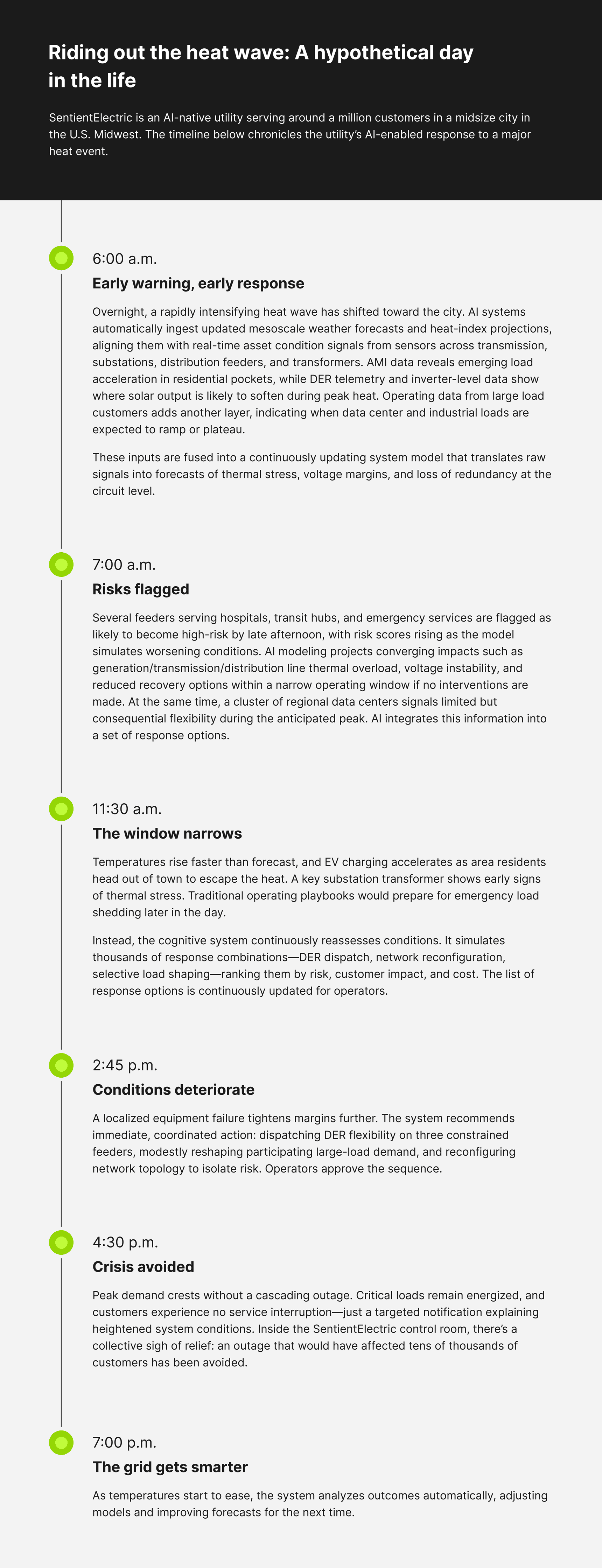
As the above scenario shows, the cognitive grid doesn't just react to a stress event—it anticipates risk, coordinates flexibility across assets and customers, continuously monitors system performance, and learns in the process.
The cognitive grid isn’t a single program or platform; it’s an operational shift. As a utility leader, you don’t need to wait for perfect data or new regulatory frameworks. Here are near-term actions you can take right now.
The industry’s operational shift to the cognitive grid is already underway. Utilities that embrace this shift and treat intelligence as an operational capability can reduce outages, improve resilience, and protect affordability without overbuilding the grid. Those that don’t will struggle to stay ahead of change.

Michelle Fay, Partner
Ted Walker, Partner
Hector Artze, Partner
Charles Maglione, Partner
Richelle Elberg, Managing Consultant
Guidehouse is a global AI-led professional services firm delivering advisory, technology, and managed services to the commercial and government sectors. With an integrated business technology approach, Guidehouse drives efficiency and resilience in the healthcare, financial services, energy, infrastructure, and national security markets.