




 Deutschland
 India
India Lietuva
 United Kingdom
 Search
 Search



This is the fourth article in a series about how energy providers can thrive in an AI-powered future.
The utility workforce is at a tipping point.
Teams are aging, with fewer apprentices entering highly specialized roles, putting decades of institutional knowledge at risk as experienced workers retire. At the same time, the grids these workers manage are becoming more distributed, dynamic, and data-intensive, with behind-the-meter resources, electrification, and extreme weather increasingly disrupting the status quo. What’s more, public expectations are rising, even as unprecedented load growth drives massive increases in capital spending and threatens affordability.
The good news is that artificial intelligence has the potential to overcome these challenges. In principle and increasingly in practice, it can augment human judgment, reduce cognitive burden, and scale expertise across the organization. When thoughtfully embedded into workflows, AI can help workers anticipate issues, test options, act with greater confidence under pressure, and close knowledge gaps. AI can surface the right insight at the right moment, automate low-value tasks, and embed safety, compliance, and best practices directly into daily work.
But utilities are complex organizations, operating safety-critical systems managed by a workforce that spans vastly different levels of digital fluency—from field crews and control room operators to planners, engineers, call center agents, and back-office staff. A line worker repairing a feeder in subzero temperatures, a grid operator managing real-time contingencies, and a customer-service agent responding to an outage all interact with data differently. And, no matter their role, few energy workers have time to pause their day-to-day tasks to quickly master new technologies and systems.
Some workers will become power users, certainly, but others will leverage AI indirectly as they come to rely on AI-enabled systems and workflows. Still others will feel threatened and resist change. AI’s impact will not be uniform. As this technology’s transformational potential grows, so do the potential risks.
So, how should energy leaders navigate these tensions?
In short, by re-envisioning work itself, not by replacing humans but by augmenting them. That new vision—and the wherewithal to turn it into action—centers on four core principles.
Leaders whose vision for AI stops at “AI is a plug-and-play productivity tool” will eventually get left behind. Those who treat AI as a new, human-governed operating capability will unlock durable value for their workers. The journey starts with developing a clear and far-reaching vision of what the road ahead looks like.
In our analysis of energy ecosystems, a recognizable progression is emerging. Automation is a typical first stage. AI is already being used to reduce manual effort in reporting, scheduling, and data reconciliation. Forward-looking utilities will then move on to predictive intelligence and machine learning: forecasting load, identifying asset risk, and anticipating outages. Over time, utilities with the right governance and data infrastructure in place will mature toward prescriptive and autonomous capabilities.
In this mature state, humans will not become obsolete. Instead, their role will evolve as AI agents become trusted collaborators. Human workers will set intent and guardrails. They’ll become orchestrators of intelligent systems, supervising algorithmic decisions, validating recommendations, and providing the domain expertise that trains AI over time.
In this scenario, AI is the digital expert, capturing and scaling institutional knowledge that would otherwise be lost. By learning from asset histories, environmental conditions, and real-time telemetry, AI can flag emerging patterns, estimate failure risk, and propose remediation options.
The result is faster, clearer decision-making built upon human experience and authority.
Over-automation without human oversight introduces risk, especially in safety-critical environments. To be trusted by workers, AI systems must be transparent and explainable. Recommendations need to be traceable to inputs and demonstrably tied to organizational goals and near-term value creation.
Equally important: Employees must believe that AI is being introduced to make their work safer and more consequential—not to devalue their roles or eliminate jobs. More specifically, trusted AI in utility procedures and processes will require:
As AI becomes embedded in daily operations, workers will increasingly need to set thresholds, validate recommendations, and perform quality checks. Data literacy will become essential: understanding where data comes from, how reliable it is, and how bias or gaps can affect outcomes. Digital fluency must expand beyond screens to include augmented reality (AR) tools, drones, robotics, and digital twins.
Above all, risk-based thinking becomes central. Instead of waiting for perfect certainty, workers need to get comfortable weighing options and making the best call with the information available.
Finally, training and enablement must match how people actually work. The most effective programs focus on specific roles and real tasks, using realistic scenarios, hands-on practice, and guidance delivered at the moment it’s needed.
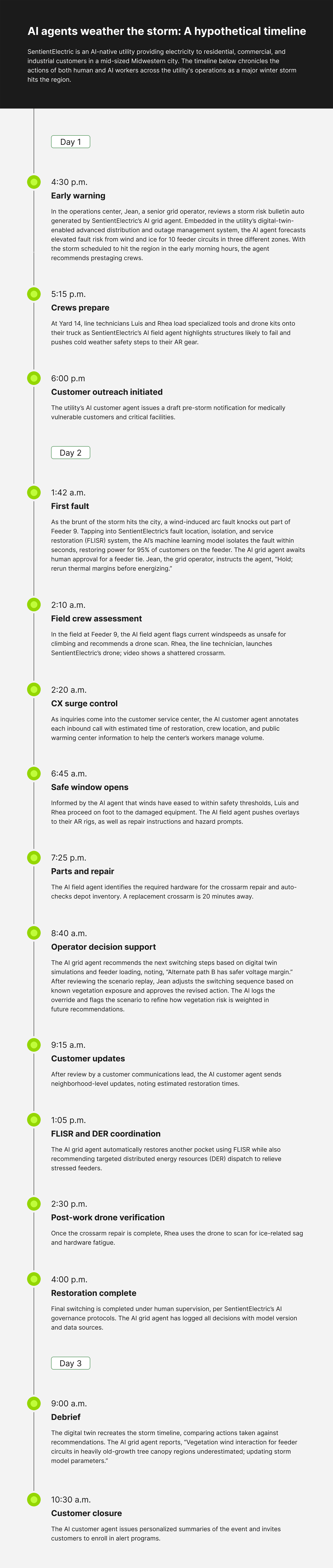
What does a mature, harmonized human-AI workforce look like in practice? And how well does it function under pressure? To give energy leaders a vivid idea of what this future might look like, we created the following imagined scenario.
An AI-enabled workforce like the one described above is achievable in the near term—but only with disciplined strategy development and effective change management. The exact development path will differ from utility to utility, but it should generally consist of seven basic steps. Individually, each constitutes a manageable and immediate action. Taken together, they represent a shift from tool adoption to a new, integrated operating model for utility work.
The real transformation comes when utilities stop treating AI as a productivity aid and start treating it as a teammate—one that must be directed, challenged, and trusted over time.
The Energy Cloud—Guidehouse’s vision of a decentralized, digitally enabled “network of energy networks”—demands a new model of work, one in which humans set direction and intelligent systems execute with speed and precision. In the Energy Cloud, AI does not replace the human heartbeat of utilities; it amplifies it.
By enabling workers to transform from operators into orchestrators, utilities can unlock safer operations, faster and better decisions, improved customer experiences, and a more resilient energy system. The utilities that succeed will be those that pair technological ambition with organizational discipline—and treat AI not as a shortcut, but as a long-term capability built around people.

Michelle Fay, Partner
Ted Walker, Partner
Meredith Bodkin, Partner
Richelle Elberg, Managing Consultant
Guidehouse is a global AI-led professional services firm delivering advisory, technology, and managed services to the commercial and government sectors. With an integrated business technology approach, Guidehouse drives efficiency and resilience in the healthcare, financial services, energy, infrastructure, and national security markets.