




 Deutschland
 India
India Lietuva
 United Kingdom
 Search
 Search



State and local courts are innovating and modernizing. Case management systems are being replaced, e-filing is expanding, virtual and hybrid hearings have become routine, and new tools—from online dispute resolution to early artificial intelligence use cases—are entering the judicial environment at record pace. These initiatives are often technically sound and well-intentioned, constituting a timely response to rising caseloads, staffing shortfalls, cyber threats, and other pressures. And yet many court modernization efforts stall, fragment, or fail to deliver their promised benefits.
The most cited obstacle is complexity. Courts are decentralized, tradition-bound, and constrained by law, making change difficult. All true, but attributing the problem to complexity skirts the real issue. The more decisive factor in determining the success of modernization efforts is readiness: To what extent is the organization prepared to absorb technological innovation and change without undermining its mission or operations?
That’s where R = MC² comes in. With a wink at Einstein’s famous equation, this simple framework—developed in 2015 by Jonathan P. Scaccia and a team of fellow organizational and community psychologists—defines organizational readiness as the product of three factors:
Readiness (R) = motivation (M) × general capacity (C) × innovation-specific capacity (C)
When adapted for a judicial system context, the framework offers a practical way for court leaders to assess modernization risk, identify what must be strengthened before implementation, and align innovation with the judiciary’s constitutional role.
Using R = MC² starts with breaking the equation down and understanding its individual variables and, crucially, their interdependence.
1. Motivation
This factor refers to leaders’ and staff’s willingness to embrace change. It can be summed up by the question, “Do leaders and users believe this modernization is necessary, valuable, and legitimate?” More specifically:
2. General capacity
This factor refers to the organizational infrastructure, culture, and governance needed to implement modernization effectively and sustain it over time. It hinges on the question, “Does the court have the foundational organizational strength to deliver change?” More specifically:
3. Innovation-specific capacity
This factor relates to the skills, resources, and technical expertise unique to a particular project and centers on the question, “Does the court possess, or have a credible plan to obtain, the specialized skills and expertise required for this specific modernization effort?” More specifically:
As the R = MC2 equation suggests, each of these variables must be mutually reinforcing if a court is to attain true readiness. High motivation without general capacity stalls projects. Strong general capacity infrastructure without motivated buy-in leads to underused systems, just as a lack of innovation-specific expertise can undermine a strong overall infrastructure.
One of this framework’s advantages is that is enables leaders to focus less on ill-defined general readiness and instead zero in on a more useful question: “Which element of readiness poses the greatest risk to this modernization effort?” Effectively answering that question using the framework requires following three deliberate steps.
Step 1: Use a scope- and bandwidth-appropriate approach to assess readiness gaps
First, find a methodology that assesses the three dimensions of readiness proportionately to the planned modernization and available resources. For example, a statewide court system undertaking a full-scale, high-stakes modernization action such as replacing its case management system might choose a structured readiness assessment such as a multi-question survey administered across the organization. Instruments like the Readiness Diagnostic Scale (RDS) provide a tested way to examine motivation, general capacity, and innovation-specific capacity in a consistent manner that enables like-to-like comparisons across individual courts or functional areas.
At the other end of the spectrum, an individual court planning a more modest modernization move within a tight timeline might conduct a focused pulse assessment—a short set of five or six carefully chosen questions drawn from RDS domains. When designed well, a brief pulse survey can quickly reveal whether judges and staff understand the purpose of the change, believe it supports the court’s mission, and feel the organization has the capacity to implement it.
Whenever possible, readiness should be assessed by role, not just in aggregate. Judicial officers, clerks, IT staff, and justice partners may experience the same initiative very differently. A concise pulse survey that reveals divergence across roles can be as valuable as a more comprehensive assessment.
Conducting a proportionate initial readiness assessment across the three R = MC2 variables is key to identifying which element of readiness poses the greatest risk to adoption and sustainability. Courts that skip this step or treat it as a formality often discover readiness gaps only after implementation is underway, when the cost of correcting them is significantly higher.
Step 2: Share results and prioritize the gaps
Once readiness gaps are identified, court leadership must confront them directly. Too often, courts proceed with procurement or rollout under the assumption that motivation will improve over time or that capacity will be built after go-live. R = MC² helps leaders isolate and articulate gaps, but successful change depends on communicating those gaps effectively and deciding how aggressively to act on them. At this stage, leaders should:
This step is as much about governance as it is about analysis. Alignment among chief judges, presiding judges, court administrators, and IT leadership is essential. Without shared agreement on readiness risks, modernization efforts are vulnerable to resistance, uneven adoption, and reversion to legacy practices.
Step 3: Address readiness gaps with targeted, court-appropriate interventions
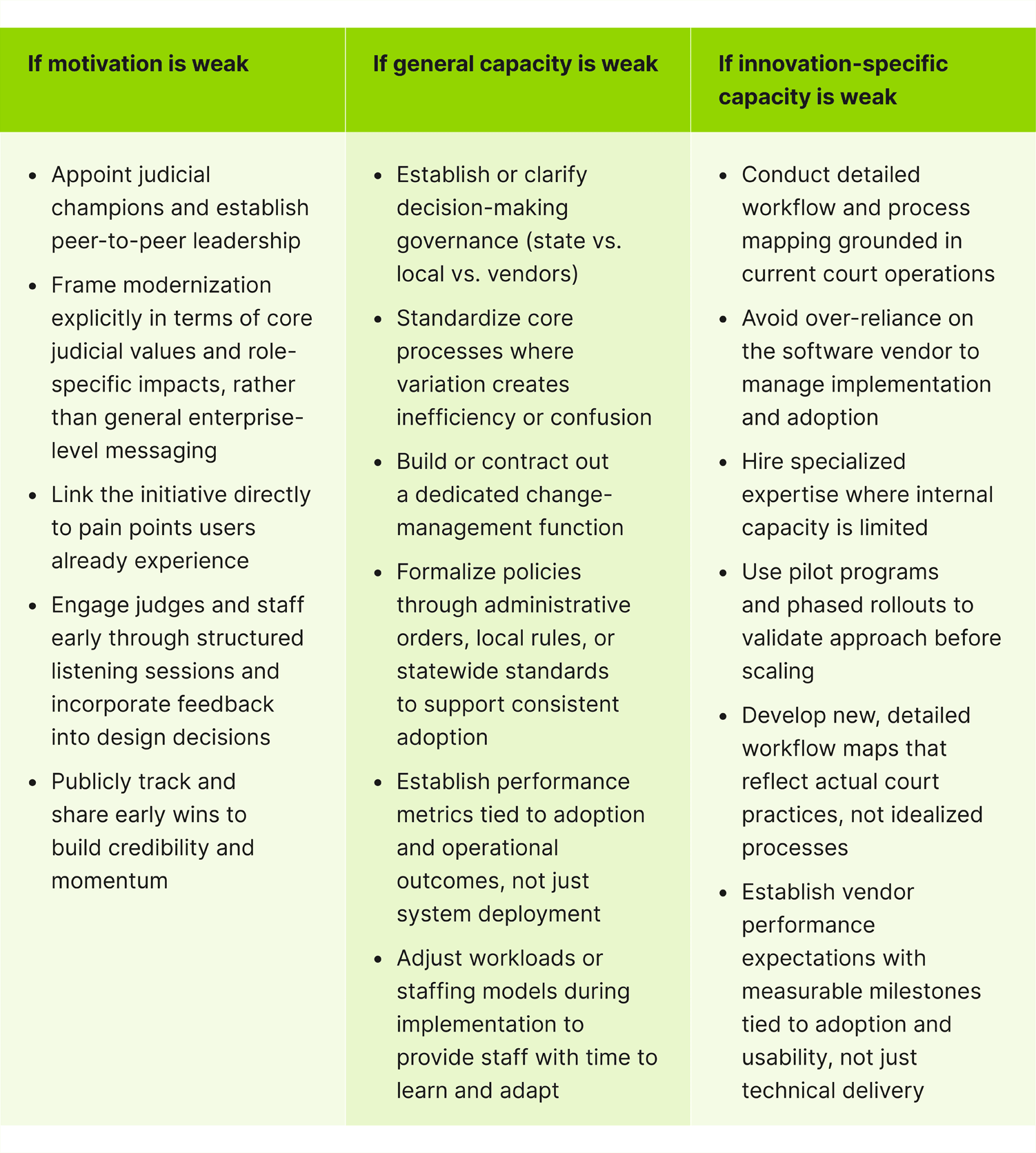
Once the readiness assessment has yielded its findings and those findings have been shared and prioritized, the final step is making concrete moves to address any gaps or weaknesses that have come to light. The nature of those interventions will depend on which of the three R = MC2 dimensions needs to be addressed. The table below outlines some potentially effective moves.
Readiness by design
The margin for error has narrowed as courts adopt new case management systems, expand e-filing, institutionalize virtual proceedings, and manage AI and emerging technologies. False starts, uneven adoption, and retrenchment after go-live are no longer just internal inefficiencies—they carry real consequences for justice access, public confidence, and institutional credibility.
The R = MC² framework offers court leaders a disciplined way to confront this reality by shifting modernization from a question of tools to a question of institutional preparedness. It also makes readiness visible by enabling courts to identify where risk actually resides rather than discovering it mid-implementation, when corrective action is most costly.
What’s more, this approach aligns with judicial values. It respects independence by emphasizing consensus-building over mandated change. It acknowledges decentralization by examining readiness across roles and jurisdictions. And it reinforces accountability by requiring that modernization be supported by governance, training, and policy.
Strictly speaking, R = MC² doesn’t simplify the work of modernization, but it does make that work more honest, intentional, and durable. Most critically, it helps leaders stay mindful of a central guiding principle: Technology doesn’t modernize courts. Courts modernize themselves.

Mitch Lindstrom, Director
Matt Davis, Partner
Guidehouse is a global AI-led professional services firm delivering advisory, technology, and managed services to the commercial and government sectors. With an integrated business technology approach, Guidehouse drives efficiency and resilience in the healthcare, financial services, energy, infrastructure, and national security markets.