




 Deutschland
 India
India Lietuva
 United Kingdom
 Search
 Search



State administrators of the Supplemental Nutritional Assistance Program (SNAP) are accustomed to seasonal workload fluctuations, typically experiencing a significant surge after a summer lull. Often, as the volume of applications, interviews, and recertifications spikes, so does activity in connected programs, including Medicaid and the Low-Income Home Energy Assistance Program (LIHEAP). This convergence places additional pressure on shared eligibility staff, portals, document systems, rules engines, and contact centers. Meanwhile, expectations for timely benefits delivery, payment accuracy, and customer service remain unchanged.
Indeed, federal standards provide a non-negotiable timeframe. Eligible households generally must receive SNAP benefits within 30 days of application, while qualifying expedited applicants must receive benefits within seven days. Timely recertification requires households to have access to benefits by their normal issuance date. What’s more, guidance from the USDA, the federal agency that administers SNAP, emphasizes that root-cause analysis, training, data systems, policy options, and corrective action planning should be part of state agencies' everyday operations, regardless of volume.
And yet many agencies manage a workload surge as one large backlog. Caseworkers and managers may know how long the queue is but have little visibility beyond that, leaving them ill-equipped to triage for the most urgent priorities, namely those that directly affect expedited service, continuity of benefits, customer access, and payment accuracy. Not surprisingly, a queue-based approach tends to favor short-term speed—chip away at the backlog as fast as you can—at the cost of downstream errors, rework, and churn.
For SNAP leaders, these challenges point to a frequently overlooked reality: Peak volume is not simply a queue problem. It is a flow problem, one that cuts across programs, channels, teams, and systems.
Gaining control of that flow requires more than a new technology platform or more detailed reporting. It calls for a governance and operating discipline, supported by a focused dashboard, that helps SNAP leaders interpret changing conditions and decide what happens next.
Think of this solution as a control tower—a workflow nexus that defines what information leaders review, how frequently they review it, who owns each workstream, which thresholds trigger action, how work moves among operational lanes, and how accuracy findings change processes before errors repeat. A control tower organizes those governance rules and decision criteria into a shared operational view.
The distinction between a conventional dashboard and a control tower is action. A dashboard in isolation displays information. A control tower uses that information to change workload routing, staffing allocations, prioritization, quality controls, and escalation protocols. If leaders can remove the dashboard and nothing about the operation changes, they do not have a control tower. They have reporting.
To support effective decision-making, a control tower should help leaders answer six operational questions:
The answers can then be assessed against state-defined thresholds and decision rules. When risk begins to emerge, the control tower prescribes a response rather than leaving each manager to interpret the same information differently.
Case age is an important factor to consider when triaging a workload queue, but basing action on case age alone isn’t sufficient during a surge. A control tower gives teams a clear view of other signals that can more effectively surface the most urgent work. These signals fall into a few consistent categories:
This wider field of view matters, because two cases of the same age may require different responses. One may be ready for completion today. Another may be blocked because a document has not arrived. A third may contain an unresolved verification issue that creates payment-error risk.
Consider a case marked “verification pending.” It may simply be waiting for action from the household, but it could also be stalled because staff have not reviewed an uploaded document, the document is unreadable, a notice is unclear, an electronic source returned no result, or a policy question remains unresolved. Gaining visibility into the specific constraint behind the verification status triggers a more targeted response, empowering teams to quickly move cases stalled by an easy-to-resolve issue or to prioritize ones that carry an immediate operational or performance risk.
How does a SNAP control tower help teams translate signals into informed decisions? The tower’s functionality consists of a sequence of five repeated, mutually reinforcing actions:
This loop allows agencies to accelerate actionable work without abandoning cases that require additional support or exposing every case to broad review. It also links speed and accuracy by directing safeguards toward demonstrated risks instead of slowing the entire inventory.
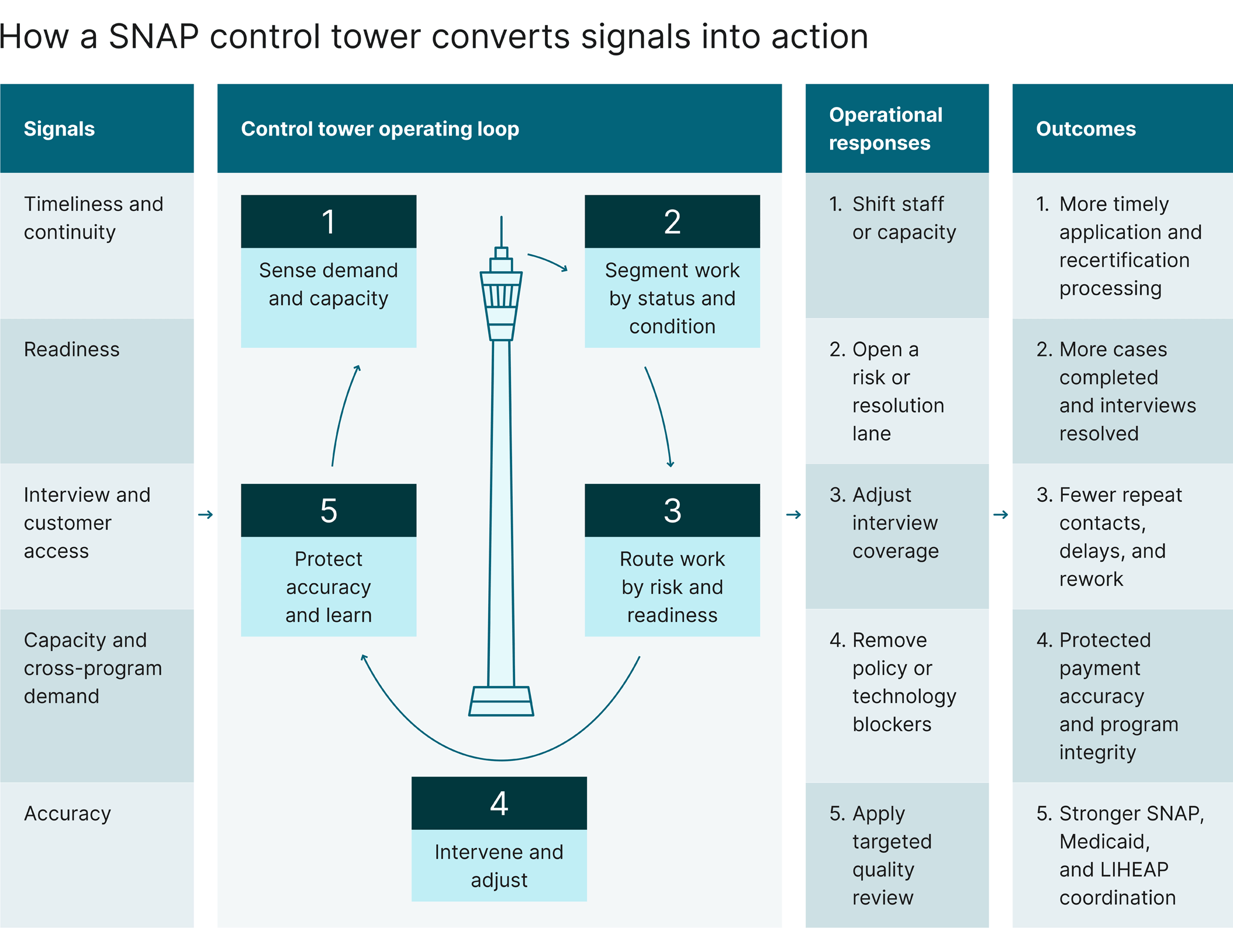
Consider a state experiencing simultaneous increases in applications and recertifications. LIHEAP season is generating more documents and calls, while Medicaid renewals are straining the capacity of shared eligibility staff and systems. Supervisors notice workers touching older cases that are not ready for action while fully actionable cases wait behind them.
During the morning surge huddle, the control tower dashboard shows that expedited applications are beginning to age. The operations lead creates a daily watch list, confirms ownership, and moves the highest-risk applications into an expedited lane. At the same time, recertifications approaching their normal issuance dates are separated from the general inventory so staff can protect continuity of benefits.
The team also sees that document volume has risen sharply. The control tower dashboard shows that many of those newly received documents haven’t been reviewed. A typical response would be to attribute the backlog to unresponsive households, but the control tower identifies an internal document-review constraint. Leaders assign a focused review block, and cases with completed interviews and actionable verification move directly into a same-day resolution lane.
Call data presents another warning. Missed interviews and repeat contacts are increasing as households seek status information. Acting on these control-tower insights, the contact-center and operations leads adjust interview coverage, improve status messaging, and organize recovery outreach for missed interviews. At the same time, the tower ensures that LIHEAP and Medicaid demand remain visible so that leaders can make staffing and system tradeoffs with a complete view of shared capacity.
Finally, as the surge begins to ease, the control tower delivers quality-control findings that reveal a recurring verification error. Instead of imposing an additional review on every case, the team uses the tower’s detailed outputs to apply targeted pre-authorization review to the affected case type and then provides a short refresher to the staff handling it.
By the end of the surge, the state has not simply asked staff to work faster. It has changed how work flows.
A control tower operating model can’t be implemented overnight. Building the new workflows and practices underpinning the model calls for a phased approach consisting of five practical steps.
1. Focus first on a single operational lane. Begin with a high-value workload, such as recertifications nearing their normal issuance dates or cases with completed interviews and actionable verification. Define which cases enter the lane, who owns it, and what successful movement looks like.
2. Define the signals and decision rules. Identify the small set of indicators leaders need to answer the six operational questions detailed above. Establish state-specific thresholds that trigger reassignment, escalation, interview adjustments, focused review, and other actions. Thresholds should reflect the state’s policies, administrative model, systems, and baseline volumes.
3. Assign decision authority. Bring together operations, policy, quality, training, reporting, contact-center, technology, and integrated eligibility leaders in order to clarify which decisions can be made in the control tower and which require executive escalation.
4. Establish a tiered meeting and review cadence. Use daily surge huddles to identify what’s changed over the past 24 hours and what must move that day. Use weekly reviews to examine trends, capacity constraints, cross-program effects, technology issues, and emerging accuracy risks. Use monthly reviews to connect performance and quality findings to root causes, training, modernization priorities, and corrective action. Every review should result in an assignment, capacity decision, escalation, or action to remove a blocker.
5. Evaluate concrete outcomes. Track whether the changes triggered by the new model have improved application and recertification timeliness, increased case completions, supported interview completion, reduced repeat contacts and rework, protected payment accuracy, and strengthened cross-program coordination. Use the results to refine signals, thresholds, and operating lanes.
A control tower can't eliminate every staffing constraint or system limitation during a SNAP workload surge. It can, however, help leaders detect pressure earlier and respond more consistently. By connecting visibility, decision-making, and action, a control tower can help SNAP agencies move beyond managing a backlog and begin managing the flow of work that has the most direct effect on timely, accurate, and accessible service.

Jason Reilly, Partner
Guidehouse is a global AI-led professional services firm delivering advisory, technology, and managed services to the commercial and government sectors. With an integrated business technology approach, Guidehouse drives efficiency and resilience in the healthcare, financial services, energy, infrastructure, and national security markets.