Anyone who has spent enough time as a state leader for the Supplemental Nutritional Assistance Program (SNAP), which provides food security for one in eight Americans, knows the drill: Every year, SNAP agencies across the country prepare and submit a Corrective Action Plan (CAP) when they fail to meet specific performance thresholds set by the USDA’s Food and Nutrition Service (FNS).
The list of triggering thresholds is very specific and, for many SNAP agencies, daunting:
- A Payment Error Rate that has exceeded 6%
- A Case and Procedural Error Rate that’s above the national average
- A Quality Control Incomplete rate exceeding 5%
- An Application Processing Timeliness rate falling below 90% for two consecutive quarters or below 80% in a single quarter
- A Recertification Processing Timeliness rate falling below 90% for two consecutive quarters or below 80% in a single quarter
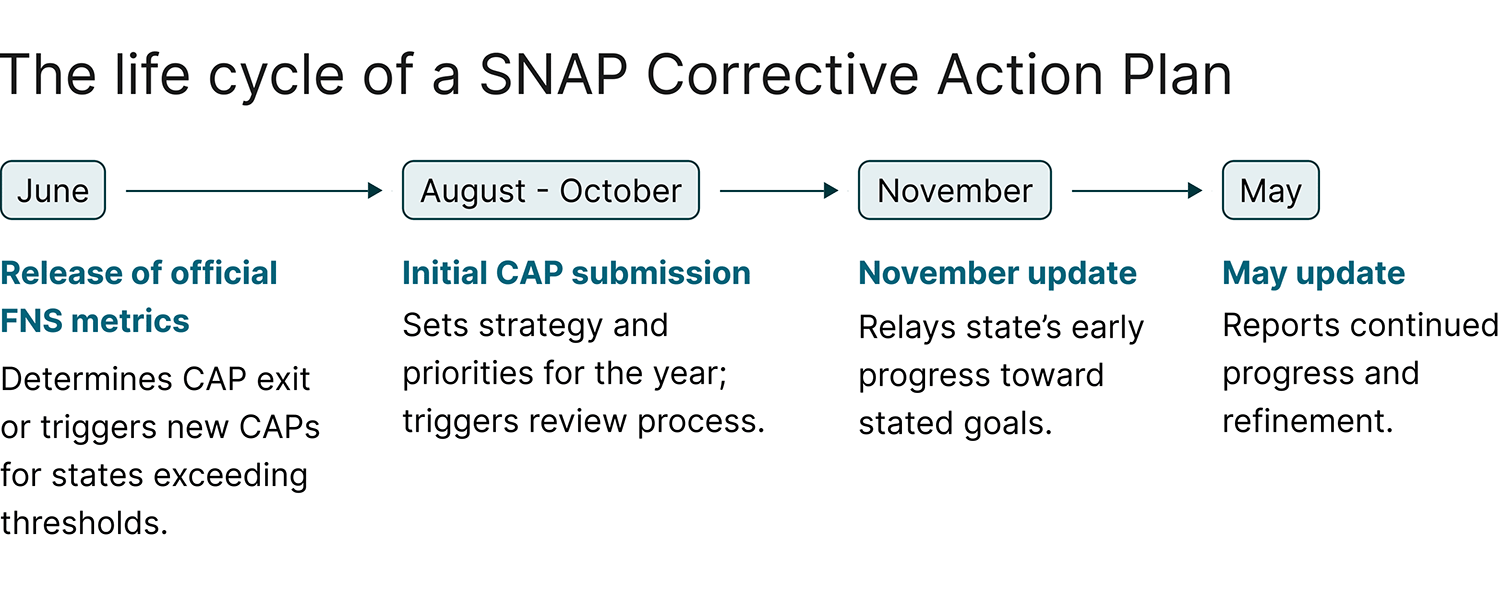
Whatever the trigger, states that exceed or fall short of FNS thresholds are required to submit a CAP within 60 days of the release of the official metrics, which typically happens in June, after which the plan is reviewed for acceptance. State agencies are then required to submit two progress updates, one in November and one the following May. When multiple thresholds are exceeded, the actions in this process can quickly multiply: A state exceeding four thresholds may be required to submit four separate CAPs, followed by four November updates and four May updates, all tied to the same performance year.
For many SNAP leaders, this compounding workload makes the CAP process feel burdensome, repetitive, and disconnected from the real work of running the program. Too often, the process produces long, inconsistent documents that federal partners find difficult to review, compare, and validate. Despite significant effort on both sides, the same deficiencies frequently resurface year after year.
The challenge is not that states don’t care or aren’t trying. It’s that the CAP process is often misunderstood. Corrective Action Plans shouldn’t be a paper chase that dutifully generates a slew of documents for federal review. Rather, they should function as a leadership tool, a way for state agencies to put into writing the priorities, timelines, expectations, and action items that will serve as an operational roadmap for program administrators and enable real change.
Identifying root causes and managing scope
Reframing CAPs in this way starts with recognizing two of the most common ways the process can get off track. The first centers on root cause analysis. Many CAPs accurately identify error categories, such as earned income, shelter costs, reporting failures, or missed timeliness standards, but stop short of identifying why those errors persist in practice.
Training gaps, worker error, or policy complexity are frequently cited as root causes, when in reality they are symptoms of deeper operational issues. Without identifying those deeper drivers—such as workload design, system limitations, unclear prompts, and inconsistent guidance and supervision models—corrective actions tend to focus on surface-level changes rather than impact.
Another frequent issue is scope. In an effort to be thorough, states often try to address every known issue in a single CAP. While well-intentioned, this approach dilutes focus and stretches implementation capacity. From a state leadership standpoint, an overly broad scope makes prioritization difficult. From a federal standpoint, ill-defined scope makes it difficult to determine which actions truly matter and whether they will be implemented successfully. A CAP that tries to fix everything rarely fixes anything.
Avoiding the November-May trap
Both of those challenges are often compounded by a lack of clarity about the difference between the original CAP submission and the November and May updates. When those distinctions are not clearly understood, the original submission becomes overloaded with caveats and updates, and the November and May submissions turn into partial rewrites of the plan. Instead of reinforcing progress and accountability, the process becomes muddled and credibility suffers.
To steer clear of this pitfall, SNAP leaders need a firm understanding of the true purpose of each CAP submission and the overall CAP life cycle (visualized below).
- The initial submission
The CAP submitted within 60 days after the official FNS release is the strategic commitment. It is where the state clearly defines what it is going to focus on over the coming year and why. This is the point at which leadership makes deliberate choices about which deficiencies matter most and which strategies are most likely to address them. At an agency where the CAP is already being used as a leadership tool, these choices are not new. They are the same priorities leadership has already been discussing internally. The initial CAP simply puts those priorities into writing, ties them to data, and translates them into clear action items.
A strong initial CAP reflects intent and discipline. It identifies the core deficiencies that triggered the CAP, documents the data and analysis behind them, and explains why certain drivers were selected as priorities over others. It then commits to a small number of corrective strategies with defined timelines and measures of progress. It acknowledges county or local office variation when relevant and explains how that variation will be addressed or managed.
Consider a state whose Quality Control data shows a high concentration of payment errors related to utility allowances, particularly in several large counties. A surface-level explanation might attribute this to worker error or inconsistent application of policy. A deeper root-cause analysis, however, might reveal that the underlying issue is unclear system prompts and inconsistent workflow guidance when utility information changes mid-certification.
In the initial CAP, this root cause should be stated plainly. The deficiency is not simply incorrect calculations; it is a process-design issue that makes correct action difficult. The corrective strategy, in turn, should be specific and limited. For example, revising system prompts and workflow guidance for handling utility changes, paired with targeted implementation support such as focused training and supervisor reinforcement, implemented over the next 10 months and monitored through Quality Assurance sample results, supervisor case reviews, and early trends in utility-related errors. This strategy should reflect decisions leadership has already made internally about where to focus improvement efforts; the CAP has simply documented them clearly for accountability.
What doesn’t belong in the initial CAP is a list of meetings. While meetings are often necessary to coordinate work and align stakeholders, they are not, on their own, corrective actions. Meetings do not change workflows, clarify system logic, or reduce error risk unless they result in concrete changes. Including meetings as standalone corrective actions weakens the CAP and obscures what is actually going to change.
The initial CAP is also not a status report. It is not meant to show progress or results, because the work has not yet begun. It is a statement of intent—a clear articulation of what the state is committing to do and how it will hold itself accountable. When written well, it becomes a useful internal reference point for leadership, staff, and partners throughout the year.
- The follow-on submissions
The November and May CAPs serve a different purpose. They are not a second, or third, opportunity to set strategy. They are progress and accountability checks. In November, the state should begin reporting on how the strategies outlined in the initial CAP are actually starting to drive change, and it should articulate what has been learned so far and include any available metrics showing early progress.
The May CAP update similarly serves as a checkpoint to report continued progress on executing the strategies and addressing the root causes identified in the initial CAP, with particular emphasis on developments since the November update. Neither follow-on CAP should be presented as a reopening of strategy.
Returning to the utility allowance example: The November CAP should describe what has happened since initial submission. Have system prompts been revised? Has updated guidance been issued and communicated to counties? Are staff using the new workflow as intended? Early indicators—such as internal QA and QC findings, error trends, or staff feedback—should be summarized to demonstrate the extent to which the strategy is taking hold.
If adjustments are needed, November is the appropriate place to explain them, so that the May update can evaluate whether the adjustments are having the intended effect. Perhaps the state learned that system changes alone were not sufficient and that additional clarification in the policy manual was necessary. That adjustment should be documented as a refinement of the original strategy, not as a brand-new direction. The root cause remains the same; the response is being strengthened based on real-world experience.
What doesn’t belong in the November or May CAP is an entirely new set of priorities. Introducing new strategies midcycle, absent a significant change in circumstances, undermines the credibility of the plan. From the federal perspective, being presented with new priorities makes it difficult to track commitments over time. From the state perspective, it sends mixed messages to staff about what truly matters.
When states understand and respect the distinct roles of the initial, November, and May CAPs, the process becomes far more effective. The initial CAP establishes direction and commitment. The November and May CAPs demonstrate follow-through, learning, and accountability. Together, they form a yearlong improvement cycle rather than three disconnected efforts. The goal of this yearlong cycle is to demonstrate that the improvements being made are sufficient to ensure that the next set of official metrics released in June fall below the applicable thresholds, allowing the state to exit the CAP. If that’s not the case, the cycle begins again with a new initial CAP tied to the latest results.
CAP as a catalyst for organizational alignment
When the CAP reflects priorities that leadership is already communicating internally, it reinforces alignment rather than creating parallel processes. When corrective actions are concrete and limited, implementation becomes realistic and teams can see progress. When meetings are treated as enabling activities rather than outcomes, the focus stays on real change.
For federal partners, this reframing improves clarity and consistency. CAPs that clearly distinguish between commitment and progress are easier to review and validate. Expectations are set early and revisited intentionally. Escalation becomes less likely, not because issues are hidden, but because good-faith effort and progress are visible.
Corrective Action Plans will always be part of SNAP oversight. That is not going to change. What can change is how states and federal partners experience the process and use it to deliver better outcomes for the households SNAP is meant to serve.





.jpg?la=en&h=170&w=310&hash=1B44A4619EFA8E406DA32569632545B3)

 Deutschland
 India
India Lietuva
 United Kingdom
 Search