




 Deutschland
 India
India Lietuva
 United Kingdom
 Search
 Search



Leaders in state government know all too well that when funding feels uncertain, the instinct is to pause new spending. This impulse is understandable—no one wants to invest only to face a budget cut—and it’s being felt acutely by administrators of the Supplemental Nutrition Assistance Program (SNAP), which provides food security to nearly 42 million Americans.
Under the recent federal legislation known as H.R. 1, states must now cover 75% of SNAP administrative costs (up from 50%) and will also have to pay a share of benefit costs if their payment error rate exceeds 6%. The new federal rules mark a turning point for states, fundamentally changing SNAP funding and raising the stakes for performance.
But even in these circumstances, not all spending is risky. Some improvements pay off under any budget scenario. These aren’t Band-Aids for major structural issues—those kind of fixes might slow a leak but can eventually lead to a dam break—but rather “no-regrets” changes that strengthen program performance whether funding expands, contracts, or stays flat. Such improvements reduce rework, prevent errors before they happen, lower long-term costs, boost staff morale, and make day-to-day operations more resilient.
Because inefficiency and errors now carry direct financial penalties for state SNAP budgets, pausing all improvements isn’t a viable option. Instead, SNAP administrators—and all health and human services leaders—need to dig into their data, pinpoint root causes of their biggest issues, and invest in the no-regrets moves that will strengthen the program no matter what. Determining those moves requires thoughtful prioritization and clear decision pathways.
Most SNAP administrators have a clear idea of the broad challenges they’re facing, whether it’s streamlining customer service, improving workflows, or preventing errors. And most have no shortage of specific ideas for meeting those challenges. Common initiatives include:
All of these can yield benefits. The dilemma is that you can’t do everything at once. Each project consumes time, money, and staff attention. The question becomes: Which challenges and solutions do you tackle first?
Without clear priorities, answering that question is all but impossible. Agencies that fail to prioritize either spread themselves too thin or freeze up altogether—each an equally bad option when mistakes now have a multimillion-dollar price tag. The path forward lies in finding a structured, objective way to evaluate projects, so that you can confidently say: This is our top priority, that one can wait.
A decision matrix is a good place to start. This grid-based evaluative tool can help eliminate subjective bias by assigning numerical scores to various projects across a set of weighted criteria. For most state SNAP programs, those criteria should be:
First, you’ll need to decide how important each criterion is to your agency. Give each one a weight of 1 to 3, with 1 signifying low importance and 3 signifying high importance. Next, list the projects you want to compare. Then assign each project a score of 1 to 5 for each of the six criteria. A score of 1 means this factor makes the project less attractive, and a score of 5 means it makes the project more attractive. Multiply each criterion score by its weight and then total the sum of those weighted scores for each project. A simple decision matrix for SNAP administrators would thus look something like this:
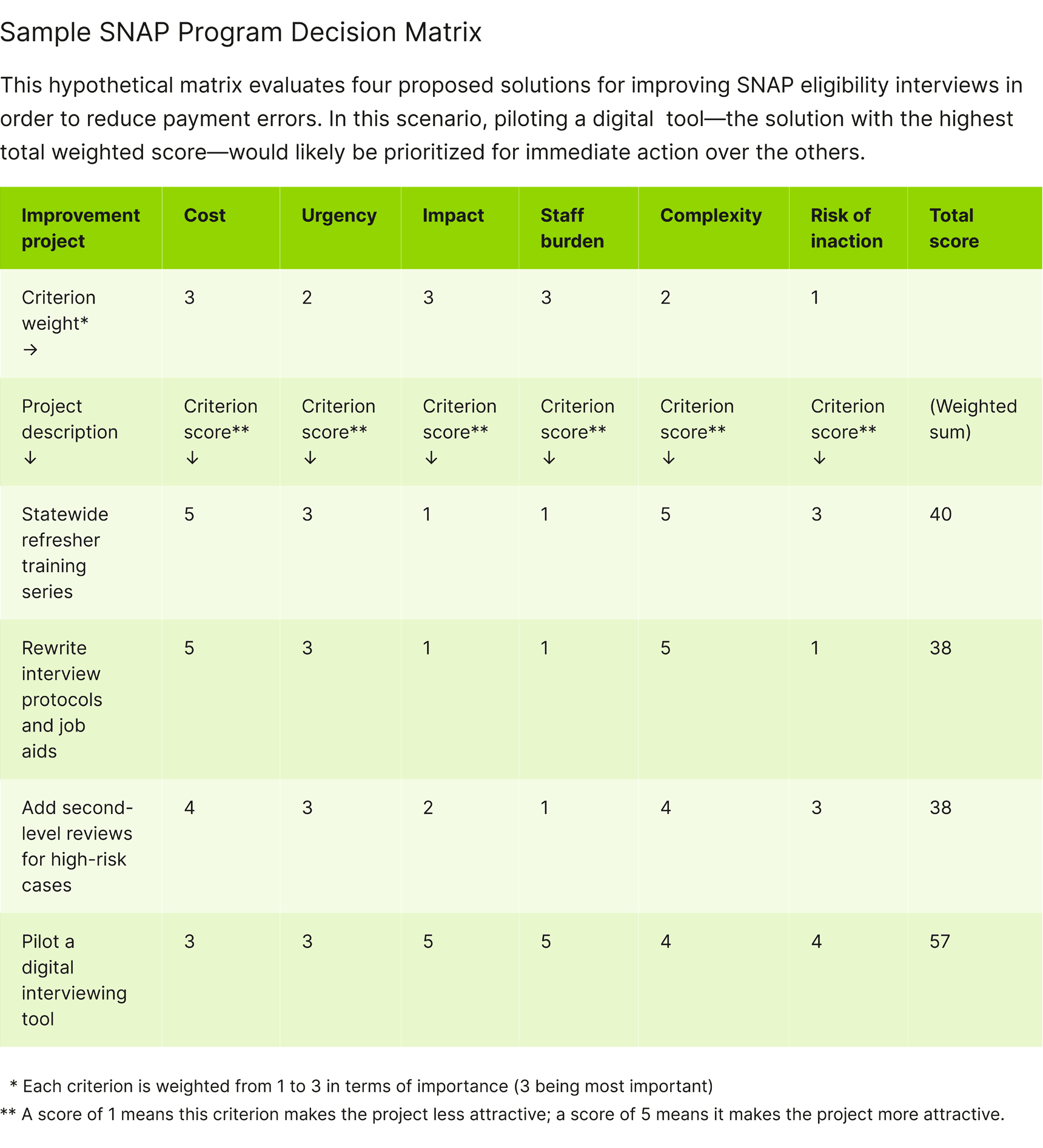
In assigning scores for each criterion, teams should draw on both qualitative and quantitative evidence, considering hard data wherever possible. For example, if 30% of errors come from a single issue, a project addressing that issue should get a high impact score. If a project would take two years to stand up, it should probably receive a low score for urgency and likely a high one for complexity.
Scoring initiatives this way paints a clear, at-a-glance picture of each project’s pros and cons. Projects receiving a high total score—for example, those that are low-cost, high-impact, and urgent—are likely the no-regrets improvements that can start right away. Projects receiving a low total score likely can be dropped or delayed. The ones in the middle might become second-phase projects.
The matrix isn’t a silver bullet, but it brings clarity, forcing administrators to articulate why Project A should be prioritized over Project B. Just as important, it gives leaders a defensible rationale for their choices, empowering them to say to stakeholders: We’re focusing on X because our analysis showed it offers the best return on investment and addresses our most urgent risks.
What does a no-regrets improvement look like for a state SNAP program? Consider the following hypothetical example.
An administrator takes a close look at the program’s eligibility interview process and notices a pattern: Workers aren't consistently asking clarifying questions when information is incomplete, resulting in pended cases, additional notices, and case notes that often lack the detail needed to support correct payment decisions.
Having identified the interview process as a root cause of payment errors, the SNAP team considers several solutions to address it: launching a statewide refresher training series, rewriting interview protocols and job aids, adding a second-level review for all high-risk cases, and introducing a digital tool to guide workers in real time.
Knowing that budgetary constraints would limit them to choosing just one initiative, the team uses a decision matrix to evaluate each option across cost, urgency, impact, staff burden, complexity, and risk of inaction. (The actual scores for this hypothetical scenario are shown in the sample matrix pictured above.) Based on agency priorities, they weight staff burden, impact, and cost higher than the other criteria. Because of this, training, rewriting protocols and job aids, and introducing secondary reviews score low. Even though those solutions would entail minimal cost, they would significantly increase staff workload and wouldn’t address the root cause of errors.
By contrast, implementing a digital tool scores well for impact (since it’s determined that the tool not only would address the root cause of errors but also could be used in multiple contexts beyond eligibility interviews), cost (the agency would participate in a pilot project offered by the tool’s producer), and staff burden (the tool requires no onboarding and little training or change to workflows). Within months of implementing the change, the team sees a marked decline in errors.
In an environment of fiscal uncertainty, prioritization is a program director’s best friend. Rather than guessing or acting on impulse, leaders can use a decision matrix to bring objective strategy to their improvement efforts. The matrix ensures that the initiatives they choose to pursue are the ones that align with their most pressing needs and offer the greatest return on investment in terms of time, money, and staff capacity.
By focusing on high-impact, high-value changes, and not getting sidetracked by less critical projects, SNAP administrators can stretch dollars and capacity without imperiling program integrity. Equally important, they can explain their choices and show that they’re stewarding public resources wisely.
Ultimately, a structured prioritization framework is a useful tool for any health and human services leadership team seeking to strengthen programs when every resource is at a premium. A structured framework enables the kind of proactive decision-making that’s key to navigating the challenges brought on by H.R. 1 and comparable future legislation.
By prioritizing well and spending smart, SNAP agencies can weather the fiscal storms ahead and emerge with a more resilient program for the people who rely on it.

Jason Reilly, Partner
Guidehouse is a global AI-led professional services firm delivering advisory, technology, and managed services to the commercial and government sectors. With an integrated business technology approach, Guidehouse drives efficiency and resilience in the healthcare, financial services, energy, infrastructure, and national security markets.