




 Deutschland
 India
India Lietuva
 United Kingdom
 Search
 Search



State workforce and labor agencies are navigating a pivotal moment of transformation. As the nature of work evolves, driven by automation, remote collaboration, and emerging industries, many states remain tied to legacy systems designed decades ago. These platforms were purpose-built for a compliance-driven era, combining labor exchange and case management in monolithic architectures focused on meeting federal reporting mandates. While they have ensured stability and consistency, they have constrained innovation.
What stakeholders expect of today’s workforce ecosystem has fundamentally shifted. Citizens demand intuitive, accessible platforms that connect them to opportunities, empower their choices, and support their broader life goals. Employers expect tools that efficiently match talent to demand. Policymakers seek real-time insight to shape economic development and training investments. The next generation of workforce systems must deliver on all three fronts, advancing equity, agility, and impact.
According to the U.S. Department of Labor, more than 40 states currently operate systems that are over a decade old. These platforms, while operationally sound, were never built to accommodate emerging trends such as skills-based hiring, AI-driven job matching, or personalized reemployment pathways. To remain relevant and effective in serving citizens at scale, state agencies must modernize.
Historically, workforce program success has been measured through compliance metrics, participation counts, service completions, and timely reporting. While these metrics remain essential, they fail to capture the true purpose of workforce systems: helping people find meaningful, sustainable employment. Job seekers and employers increasingly expect digital experiences that are on par with private-sector platforms, not portals constrained by outdated interfaces and rigid workflows.
When these legacy systems fail, the consequences are human. A job seeker facing unemployment may encounter an interface that is confusing or inaccessible, adding frustration to an already stressful experience and potentially lengthening the employment search. Employers attempting to fill urgent roles find outdated job matching that fails to interpret skills equivalency. Caseworkers spend more time navigating screens than engaging citizens. The result is inefficiency at a moment when human connection and guidance are most critical.
The future of workforce systems must reorient around people, not programs. This requires viewing technology as an enabler of empathy, equity, and empowerment. It means adopting architectures that can evolve as rapidly as the workforce itself and redefining success around outcomes, not just outputs.
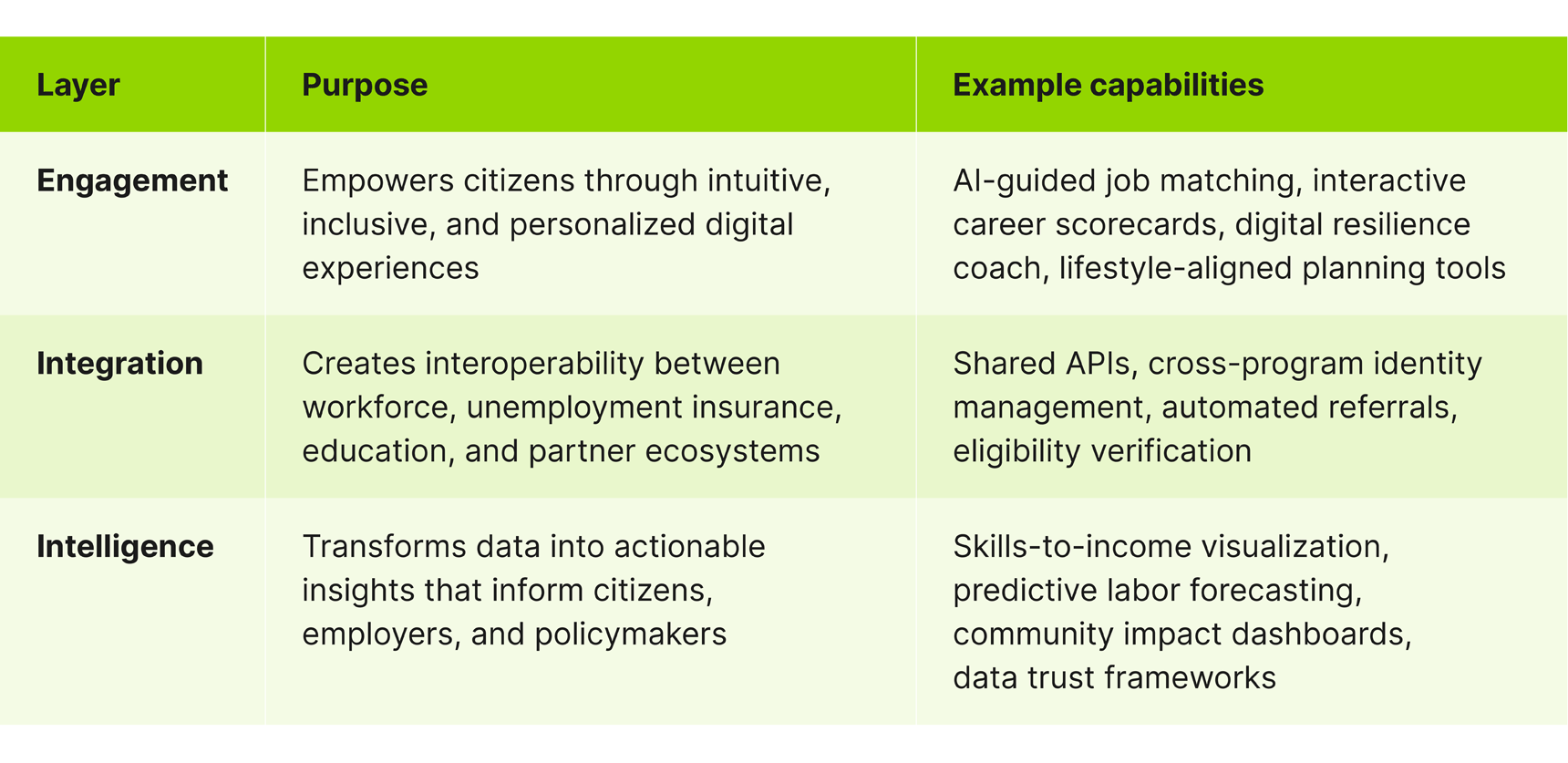
A workforce experience architecture model provides a strategic framework for building the next generation of workforce ecosystems. The model organizes transformation into three integrated layers that work together to deliver flexibility, scalability, and citizen-centric experiences.
This architecture allows states to modernize incrementally, introducing best-of-breed components while maintaining interoperability. It reflects a shift from owning systems to orchestrating ecosystems. Ultimately, the model can help states plan, design, and implement modernization strategies that are aligned with mission, funding, and community outcomes.
Most state systems today combine case management and labor exchange functions in a single application. Though this approach ensures compliance with federal mandates, it limits agility, customization, and innovation. Decoupling these capabilities, while maintaining a shared data foundation, unlocks the ability to evolve each component independently.
A modular, API-driven ecosystem allows states to integrate new AI or analytics capabilities without replacing entire systems. This architecture also supports flexible procurement, enabling states to onboard smaller, specialized vendors alongside enterprise platforms. The result is a living ecosystem that can grow and adapt as technology and policy change.
For many citizens, the labor exchange represents their first interaction with the workforce system during a period of instability. Losing a job is not just a financial challenge. It can be a profound emotional one. A human-centered design acknowledges this reality, creating experiences that guide, support, and motivate. When implementing such a design, a few specific tools, approaches, and principles can provide critical support:
Modernizing workforce systems is a civic imperative. The tools that states build today will determine how future generations navigate change, develop skills, and achieve stability. By adopting modular, intelligent, and human-centered approaches, states can redefine what public service feels like, making it accessible, empathetic, and empowering.

Steven Duart, Partner
Guidehouse is a global AI-led professional services firm delivering advisory, technology, and managed services to the commercial and government sectors. With an integrated business technology approach, Guidehouse drives efficiency and resilience in the healthcare, financial services, energy, infrastructure, and national security markets.