




 Deutschland
 India
India Lietuva
 United Kingdom
 Search
 Search



While federal agencies spend billions on IT each year, a large percentage of that spend is dedicated to operating and maintaining existing systems instead of modernization initiatives. As technology environments expand, organizations often find themselves investing more resources in maintaining systems than in improving outcomes. According to Gartner, large enterprises in 2025 were operating an average of 45 cybersecurity tools—a figure that reflects years of reactive procurement more than deliberate architecture.
One of the primary drivers of this imbalance is IT sprawl.
IT sprawl is the unchecked accumulation of hardware, software, cloud services, and data systems across an organization. What makes this phenomenon particularly challenging is that it occurs gradually. Tool accumulation is often the byproduct of years of reactive purchasing, evolving compliance requirements, and the natural growth of security programs. These incremental additions can produce security environments where tool redundancy goes untracked, maintenance overhead continually rises, and data visibility becomes increasingly difficult to maintain.
In a mature security organization, the tool ecosystem often spans:
Each tool is typically deployed to address a specific threat vector, compliance requirement, or operational need. While each one serves a legitimate function in isolation, the challenge of IT sprawl emerges at the seams. When these tools operate in parallel without a unifying architecture, data often remains siloed within individual platforms. Without shared context across systems, alert volumes grow alongside false positive rates.
As analysts triage this environment, they must manually pull context from one platform, cross-reference it against another, and reconcile outputs across systems that weren’t designed to interoperate. This operational burden of managing noise and switching between platforms reduces the time available to identify and respond to real threats.
IT sprawl in security environments is driven by structural conditions that can make consolidation difficult. Procurement processes in large organizations—particularly in government and regulated industries—are deliberately methodical, incorporating security reviews, compliance validation, and interoperability assessments. When approved processes move slowly relative to operational need, teams may adopt tools outside formal procurement processes, adding to an already complex stack.
Decentralized budget authority introduces a parallel challenge. When technology spend is distributed across departments, purchasing decisions are often made in response to local team needs rather than the enterprisewide architecture. This approach leads to functional duplication, with multiple teams carrying tools that address the same problem without central governance to mitigate the overlap.
Legacy systems add a third layer of complexity. Platforms embedded in critical workflows persist alongside newer systems due to migration risk, institutional familiarity, or the absence of a clear modernization mandate. These legacy systems can accumulate maintenance needs while offering limited interoperability with the broader environment.
Together, these conditions produce security environments where investment in tools risks outpacing the capacity to derive coherent intelligence from them.
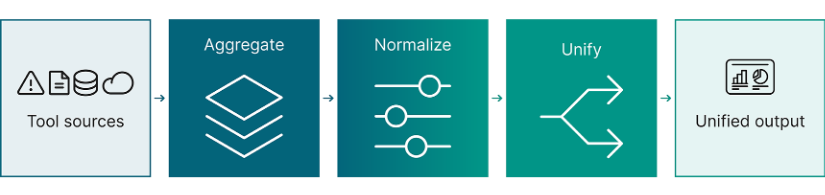
Addressing IT sprawl isn’t simply a matter of reducing tool count. Security functions across detection, response, identity, compliance, and vulnerability management require specialized capabilities that a single platform is unlikely to replicate. The more productive question becomes whether the existing tools contribute to a unified operational picture or operate in isolation.
Achieving the former requires two foundational shifts: centralizing the data those tools produce into a unified view and implementing automated processes to act on that data at scale, in real time.
The starting point for IT sprawl remediation is visibility: a unified view of what tools exist across the environment, what data is produced, and how the output relates to organizational risk. This begins with establishing a centralized data architecture that aggregates telemetry, alerts, and logs from across the security stack into a single, normalized repository.
Centralization alone isn’t sufficient if the underlying data is inconsistent. Tools across a fragmented environment frequently apply different frameworks, severity classifications, and alert formats. Before that data can support meaningful analysis, it must be cleaned and normalized. At enterprise scale, this process can’t be performed manually. AI-enabled automation addresses this gap by applying consistent machine learning and analytical intelligence to structure data regardless of its source, surfacing the signal that warrants analyst attention.
Then the clean, centralized, continuously updated data can serve as the foundation for every security function that follows.
With a centralized data layer in place, an organization’s security operations center is better-positioned to fulfill its core functions: analysis, investigation, and response coordination. In practice, this means analysts working from a unified security dashboard that ingests data from across the tool ecosystem, including SIEM, IAM, endpoint detection and response, and vulnerability management platforms.
The measure of a well-integrated security environment isn’t the sophistication or quantity of its tools but the clarity it produces—for both the analysts managing threats in real time and the leaders accountable for organizational risk.

Cindi Bassford, Partner
Nancy Sieger, Partner
Phil Boone, Director
Guidehouse is a global AI-led professional services firm delivering advisory, technology, and managed services to the commercial and government sectors. With an integrated business technology approach, Guidehouse drives efficiency and resilience in the healthcare, financial services, energy, infrastructure, and national security markets.