




.jpg?la=en&h=170&w=310&hash=1B44A4619EFA8E406DA32569632545B3)

 Deutschland
 India
India Lietuva
 United Kingdom
 Search
 Search



Enterprise AI is entering a new phase. Organizations are moving from tools that support individual tasks to agents that retrieve data, call tools, recommend actions, and influence workflows. That shift raises the stakes. When an AI chatbot lacks context, it may give an incomplete answer. But when an AI agent lacks context, it may take the wrong action, leading to more serious consequences.
Agentic AI efforts can stall if agents are operating in fragmented environments where data, definitions, rules, and workflows don’t align. Leaders need to build context into the AI operating model from the start so agents can use the right information and follow the right constraints. Efforts that move beyond pilots should focus on building the data and AI foundation that lets agents operate with trust, consistency, and measurable value.
Four forms of context determine whether enterprise AI agents can move from experimentation to trusted production.
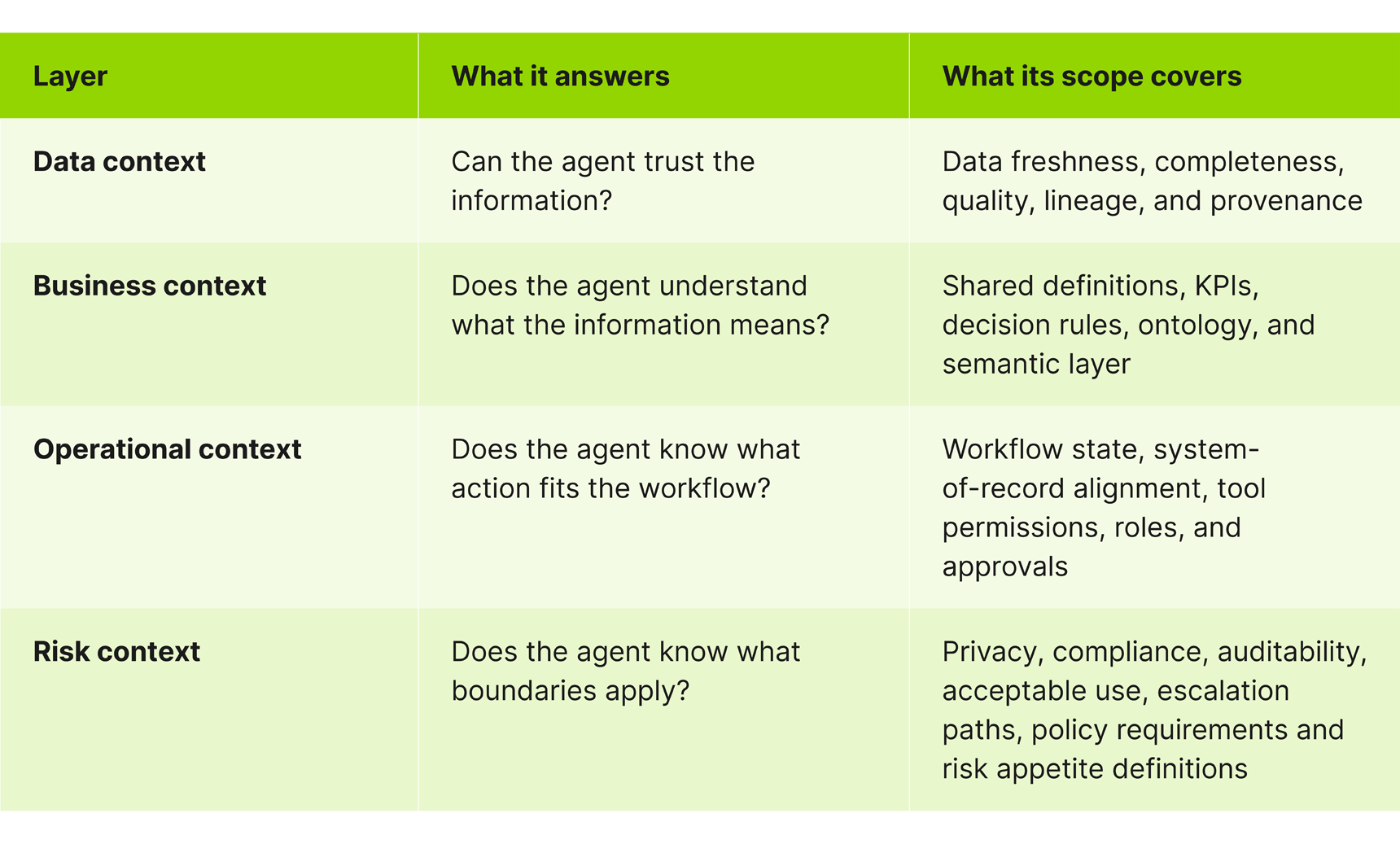
Together, these layers turn enterprise information into usable context for agentic workflows.
AI agents depend on the quality and consistency of the data environments around them. When enterprise data lives in disconnected systems, uses inconsistent definitions, or lacks clear ownership, agents may produce outputs that look useful but require manual validation, or act on an incorrect decision. A unified data and AI foundation such as a lakehouse-style approach changes that equation by bringing structured and unstructured data, analytics, governance, and AI development into a more consistent environment.
Ontology-based semantic layers and knowledge graphs encode business meaning, connect related concepts, and help agents interpret enterprise data in context. Ontology is a structured map of an organization’s business meaning: the terms, metrics, entities, relationships, rules, and trusted sources that help AI agents understand what enterprise-specific data means. The most agentic-ready data platforms treat ontology as a live context layer that continuously learns from governed data and connected systems, which helps agents retrieve more accurate answers. With shared definitions, governed access, automated quality checks, and near real-time signals, agents can support proactive workflows such as anomaly detection, exception handling, reconciliation, and process optimization.
Pilots succeed because they control the use case, data, and path to action. Production environments introduce changing data, evolving policies, exceptions, and inconsistent system signals. To scale agents responsibly, AI leaders need a live context layer that connects governed data, business definitions, operational signals, and policy constraints so agents can interpret requests in the right business context and act within approved boundaries.
An ontology helps make that context operational. As data, workflows, policies, and user behavior change, the ontology and supporting context layer change with them so that agent behavior stays aligned with current business meaning—not stale assumptions from the original pilot.
Evaluating agent performance shouldn’t stop at launch. Teams should continuously monitor and test whether agents are retrieving from authoritative sources, applying the right definitions, respecting workflow constraints, and escalating uncertain or high-risk cases to human reviewers. Leaders should define fallback behavior before failures occur and treat agent performance, ontology quality, and context freshness as ongoing operational responsibilities.
Organizations don’t need to solve every data and governance challenge before deploying AI. But they should take these key actions to prioritize the capabilities that allow agents to operate safely and deliver measurable value.
AI agents can elevate enterprise performance, but only when leaders strengthen the foundation beneath them. Autonomy without context creates risk. Autonomy with accurate data, shared business meaning, governed access, and clear accountability creates the conditions for better decisions, faster workflows, more reliable outcomes, and better cost control.
In this next phase of enterprise AI, context isn’t background infrastructure, but rather the control layer that makes trusted autonomy possible.

Karen Odegaard, Partner and AI Leader
Leigh Sheldon, Partner
Guidehouse is a global AI-led professional services firm delivering advisory, technology, and managed services to the commercial and government sectors. With an integrated business technology approach, Guidehouse drives efficiency and resilience in the healthcare, financial services, energy, infrastructure, and national security markets.