




.jpg?la=en&h=170&w=310&hash=1B44A4619EFA8E406DA32569632545B3)

 Deutschland
 India
India Lietuva
 United Kingdom
 Search
 Search



This article is the seventh in a series about how utilities can thrive in an AI-powered future.
Utilities today face multiple, overlapping challenges: intensifying affordability pressures, accelerating policy change, the rapid addition of new assets to the grid, and heightened scrutiny following major reliability and cybersecurity events. Together, these forces are dramatically expanding the complexity and volume of utility compliance obligations, while exposing the limits of traditional, manual approaches. What's more, compliance is increasingly tied to grid safety, resilience, cost containment, decarbonization, and public trust.
The traditional way compliance has been executed simply can’t keep up. Most utilities still rely on document-heavy, labor-intensive processes, with data spread across enterprise silos. Compliance work is often episodic—intensifying ahead of audits, filings, or evaluations, then receding once immediate requirements are met. That model struggles in a dynamic environment where mandates evolve, requirements shift or sunset, and utilities must continuously demonstrate prudent use of customer dollars.
AI won’t change what utility compliance demands, but it can fundamentally change how securely, efficiently, and continuously compliance can be achieved—and it will likely impact how regulators approach enforcement in the future. By automating repetitive compliance tasks and reducing manual reconciliation, AI can free up skilled utility personnel to focus on higher-value operational, planning, and customer-facing activities—improving workforce productivity without reducing the need for human expertise.
For utilities, AI presents the opportunity to evolve compliance from a reactive obligation into a scalable, defensible capability—and, in some cases, a source of operational and strategic value.
Utilities are grappling with two principal layers of compliance obligations: broad, federally mandated requirements and diverse, localized laws and regulations. The former is defined by uniform rules and high-consequence enforcement on a national and regional scale, while the latter is shaped by fragmented mandates and outcome-based evaluation in diverse states and locales.
No matter the type of regulatory obligation, utilities are under mounting pressure to operate at scale—across assets, programs, jurisdictions, and time—even as the compliance surface area grows. While spreadsheets may suffice when thousands of assets are being managed, such manual processes aren’t adequate for a much larger asset base. In many places, this growth is happening faster than existing compliance resources can absorb. As new assets are integrated, gaps in visibility, configuration, and control are being exposed—often after the fact through audits or incidents. These situations introduce real financial risk.
From NERC reliability and cybersecurity standards to FERC-related requirements to oversight by regional entities such as WECC, federal and regional frameworks are highly standardized and audit-driven. Compliance in these domains is inseparable from safe, secure grid operations. Failures aren’t theoretical; they can expose utilities to reliability risk, enforcement actions, reputational damage, and material financial penalties.
Traditionally, these regimes have been enforced through backward-looking audits, leaving systems exposed and compromising safety. Utilities often assemble evidence after the fact, reconcile documentation across systems, and respond to findings once gaps are identified. This approach is costly and disruptive. More importantly, it limits a utility’s ability to correct issues as processes evolve—leaving operators scrambling to fix problems only after they’re revealed through an audit.
AI enables a fundamentally different model. Instead of preparing for audits periodically, utilities can move toward continuous audit readiness. Automated evidence capture, documentation classification and validation, configuration tracking, and real-time exception analysis all allow compliance teams to surface risks early before issues arise or financial impact occurs.
Call it the “virtual auditor” model. Rather than discovering gaps months after they emerge, AI-enabled systems monitor controls and configurations continuously, flagging deviations as they happen. The result is fewer surprises during audits, stronger operational discipline, and lower long-term compliance costs. Just as important, virtual auditing reduces the likelihood of penalties and expensive corrective actions.
Beyond risk reduction and cost containment, AI-enabled compliance can create strategic advantages for utilities operating in increasingly dynamic markets. In contexts such as transmission acquisitions, asset integration, or competitive procurements, compliance maturity is no longer just a defensive requirement. It directly influences decision speed, confidence, and optionality.
Continuous visibility into compliance posture allows utilities to distinguish between true risk and manageable exposure, enabling precise, evidence-based judgments. This can materially affect bidding strategies, integration timelines, and post-transaction risk profiles.
More broadly, AI-enabled compliance intelligence strengthens a utility’s ability to act under uncertainty—whether responding to policy shifts, market opportunities, or system stress—without sacrificing credibility and control. This strategic benefit doesn’t come from loosening standards or bypassing oversight. It emerges from stronger traceability, faster insights, and earlier intervention, all anchored in human accountability.
Not every utility decision hinges on compliance sophistication—but in high-stakes moments where timing, confidence, and defensibility matter, AI-enabled compliance can expand the range of feasible actions. In those cases, compliance stops being a constraint on strategy and becomes an enabler of prudent, well-timed decisions.
State-level mandates introduce a different challenge. Programs related to energy efficiency, clean energy, resilience, demand flexibility, and wildfire mitigation vary widely in structure and economic treatment. Requirements differ by state, and metrics aren’t uniform. Often, utilities don’t control how programs are evaluated.
Here, compliance extends beyond execution. Cost recovery may depend on demonstrating that programs worked, were affordable, and delivered equitable benefits—leaving utilities vulnerable to serious financial impacts if a program and its associated investment are disallowed in a rate case. Regulators and third-party evaluators are tasked with determining whether outcomes justify continued spending—often under intense public and political scrutiny.
This creates a new layer of complexity: Compliance depends on proving impact as much as meeting requirements.
AI’s role in this context spans the full program lifecycle, whether for demand-side customer programs or for resilience programs designed to address worsening wildfire and storm impacts. AI supports better strategy and design by helping utilities target the right customers and measures upfront. During implementation, AI tools can monitor participation, performance, and data quality in near-real time rather than forcing utilities to wait for retrospective studies. During evaluation and reporting, they can assist with data cleansing, qualitative synthesis, impact analysis, and development of defensible narratives that explain results.
Over time, this enables faster feedback loops. Programs can be adjusted earlier, wasted spend can be reduced, and outcomes can be better aligned with affordability goals. AI-enabled compliance becomes a mechanism for learning and improvement, not just accountability. At the same time, it can serve as a powerful tool for responding to regulator demands, as the following hypothetical scenario demonstrates.
In our imagined scenario, “SentientElectric” is an AI-native utility providing electricity to residential, commercial, and industrial customers in a midsized Midwestern city. “TradElectric” is a neighboring utility subject to the same state regulations. The state’s Public Utilities Commission (PUC) raises concerns during a public workshop that customer-funded load-flexibility programs may not be operating at their full potential. Commissioners emphasize that underutilized demand programs can exacerbate affordability pressures by forcing infrastructure investment and raising procurement costs. The PUC announces that utilities will be expected to demonstrate how these programs are being optimized to deliver value. Below, we outline the actions each utility takes in response.
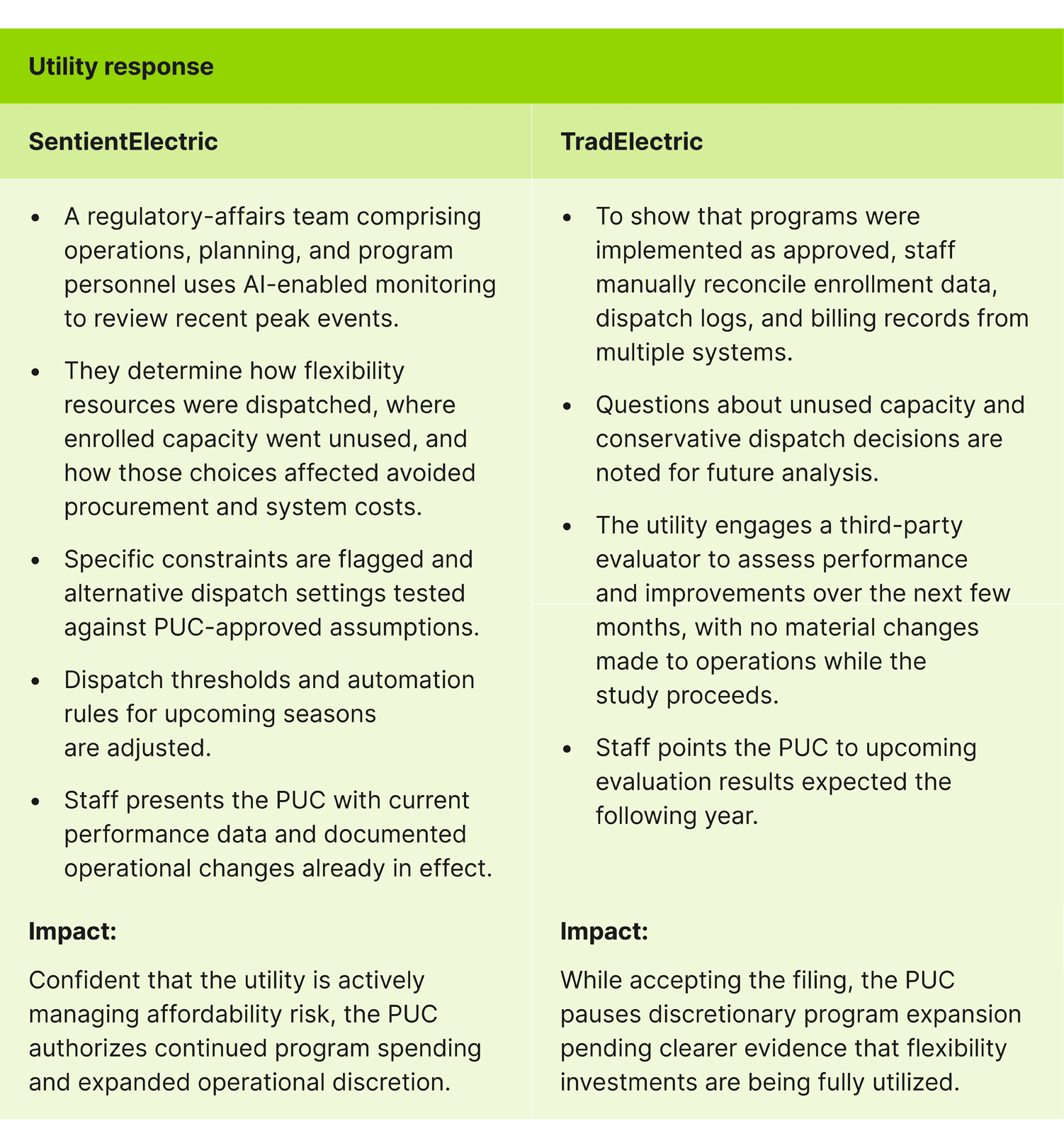
When AI is applied consistently, compliance stops being a siloed afterthought and becomes a horizontal capability spanning planning, operations, cybersecurity, and customer programs. Compliance data in turn becomes an active management asset.
Instead of being archived after audits conclude, compliance insights inform where operational or security risks are accumulating, which assets or programs are underperforming relative to mandates, and how future requirements can be met with lower marginal effort. That enables utilities to optimize from the outset—designing programs, processes, and controls with compliance in mind—rather than correcting problems after the fact.
This is where compliance begins to resemble an efficiency layer across the enterprise. The same data and analytics that support compliance can strengthen operational decision-making, improve coordination across teams, and reduce redundant effort.
Turning AI-enabled compliance into a value engine is less about technology selection and more about sequencing, discipline, and credibility. The risk for utilities isn’t moving too slowly but moving in ways that appear ad hoc, opaque, or misaligned with regulatory expectations—undermining trust before value is realized.
AI introduces powerful new capabilities into the compliance function. But those capabilities only translate into durable outcomes when they’re embedded thoughtfully into existing governance, workflows, and oversight structures. Utilities must balance speed with rigor, innovation with explainability, and automation with clear human accountability.
The actions below constitute a practical, execution-oriented path that utilities can follow. It prioritizes trust, builds internal and external confidence incrementally, and aligns AI adoption with how compliance is actually evaluated by regulators, auditors, and third-party reviewers. Utilities should:
For their part, regulators and oversight bodies should consider how to adapt to new AI-enabled capabilities, allowing for deviation from the status quo of manual processes and documentation. They should develop incentives for new solution implementation and introduce standardized compliance platforms to streamline utility audits and responses.
Compliance requirements will continue to grow even as affordability constraints tighten, load grows, and new asset integration accelerates. Utilities are being asked to do more with less while delivering reliability, security, equity, and decarbonization outcomes under increasing scrutiny.
AI isn’t a shortcut around these obligations. But it’s emerging as the only scalable way to meet rising expectations, lower costs, reduce risk, and adapt quickly as mandates evolve. Done correctly, AI-enabled compliance strengthens the grid, improves credibility, and turns what was once a drag on the system into a source of grid resilience, safety, and strategic value.

Michelle Fay, Partner
Ted Walker, Partner
Eduardo Balbis, Partner
Jenny Hampton, Partner
Richelle Elberg, Managing Consultant
Guidehouse is a global AI-led professional services firm delivering advisory, technology, and managed services to the commercial and government sectors. With an integrated business technology approach, Guidehouse drives efficiency and resilience in the healthcare, financial services, energy, infrastructure, and national security markets.