




 Deutschland
 India
India Lietuva
 United Kingdom
 Search
 Search



Federal agencies can pilot AI quickly—but proving that systems will behave reliably remains the biggest barrier to production use. Many agencies have launched pilots, created AI councils, and adopted cloud-based AI services. Yet these efforts often stall before operational use due to delays in architecture, authorization, and oversight decisions.
When you select AI capabilities before you fully understand authorization paths, your security and oversight teams must retrofit controls into systems that weren’t designed for continuous monitoring. As you move AI into mission workflows, the governance you put in place must go beyond compliance reviews and authorization approvals. You need an operating model, controls, oversight, and decision rights to manage how AI systems behave, evolve, and interact in production.
This is an urgent challenge as agencies adopt AI systems that retrieve data, call tools, connect to external services, and influence operational workflows. These capabilities can create value, but they also weaken the case for one-time reviews.
That’s why federal assurance models are changing. FedRAMP 20x—the U.S. General Services Administration initiative that’s modernizing how cloud services are vetted and authorized for government use—reflects a push toward significantly shorter authorization timelines, particularly in lower-risk pathways. Initial pilots have focused primarily on low-impact pathways, but Phase 2 pilots are extending the model toward moderate systems. Together, these efforts prioritize automated controls, machine-readable evidence, and continuous validation rather than static documentation alone.
With these expectations at the forefront, your agency needs to adapt by:
Moving AI from pilot to production
These changes matter most to moderate and high-impact systems, including cybersecurity operations, health systems, benefits delivery, law enforcement, and operational decision support. Even as lower-risk acceleration paths mature, these workloads still require rigorous oversight and continuous assurance.
Agency-built AI systems may provide stronger mission alignment and control, but they need internal oversight and lifecycle management. SaaS-embedded AI and commercial AI APIs can accelerate deployment, but they can also create dependencies on external hosting environments, vendor-controlled evidence, evolving authorization boundaries, and runtime model behavior that you can’t fully observe.
The agencies that are making measurable progress are narrowing their portfolios, prioritizing use cases with clear authorization paths, and evaluating vendors more rigorously. They recognize that AI can’t be layered onto processes that are poorly defined or not ready to scale.
Before automating, you need to assess process maturity, data readiness, control ownership, measurable performance outcomes, and the ability to continuously validate system behavior. Otherwise, AI can accelerate inconsistency rather than improve mission outcomes.
Traditional federal security models have focused on infrastructure protection, identity management, encryption, logging, and access controls. Those safeguards remain essential, but they don’t fully address how AI behaves in operation. Models can drift, disclose sensitive information, hallucinate outputs, or respond unpredictably under adversarial interaction.
Federal agencies also face risk at the model layer itself. Adversaries can use normal interactions to infer sensitive information, recover patterns, or replicate valuable behavior. This risk grows as AI systems connect data, retrieval pipelines, tools, feedback loops, and external services. These systems do more than generate outputs—they can influence workflows, invoke tools, and affect environments beyond the original authorization boundary.
Traditional infrastructure monitoring can miss these forms of behavioral risk. As systems evolve, your agency needs the ability to continuously observe model behavior, validate lineage, investigate anomalous responses, and enforce runtime controls. To govern models as operational assets, you should use approved model registries, evaluation results, red-team findings, prompt and output logging, change control, incident response procedures, and retirement criteria.
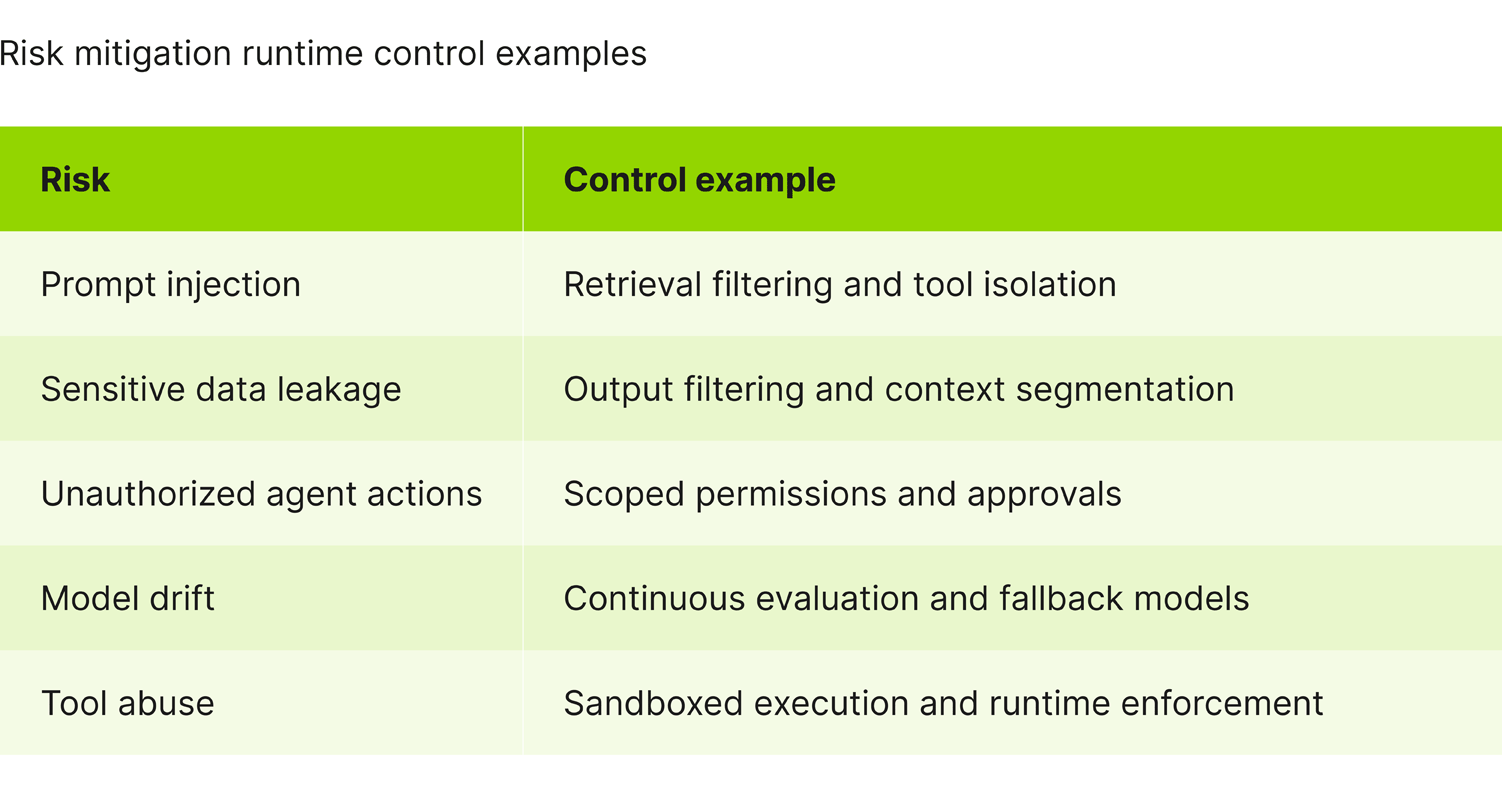
As your agency moves AI into mission use, you can reduce authorization friction, limit rework, and strengthen confidence as you scale the technology by prioritizing:
As AI environments become more interconnected, you need operating models for runtime oversight, continuous monitoring, risk-based review, and clear controls for agentic systems.
To move AI from pilots to operational use, your agency leadership should:
Trust as a mission capability
Successful agencies move AI into authorized, monitored, mission-effective use while maintaining trust as systems evolve. FedRAMP modernization and evolving AI architectures are pushing federal assurance toward continuous validation, runtime oversight, and operational resilience. By building these capabilities, you can scale AI with greater confidence, fewer retrofits, and stronger alignment to mission and oversight requirements.
These insights are derived from Guidehouse’s AI Studio, which operates at the intersection of proven expertise and emerging technology. We help you move from idea to impact—quickly, securely, and responsibly—through capability modules designed for reuse, integration, and scalability. Built with human-in-the-loop oversight, these modules combine automation with expert review to ensure accountability, accuracy, and trust.
Guidehouse is a global AI-led professional services firm delivering advisory, technology, and managed services to the commercial and government sectors. With an integrated business technology approach, Guidehouse drives efficiency and resilience in the healthcare, financial services, energy, infrastructure, and national security markets.