




.jpg?la=en&h=170&w=310&hash=1B44A4619EFA8E406DA32569632545B3)

 Deutschland
 India
India Lietuva
 United Kingdom
 Search
 Search



This is the final article in a series about how utilities can thrive in an AI-powered future.
Artificial intelligence is reshaping the electric utility landscape in profound ways, from enhancing planning and forecasting to transforming grid operations, regulatory compliance, the workforce, and customer engagement.
At the same time, AI is exposing challenges that have long existed within utility operating models. Siloed functions, lengthy planning cycles, and disconnected data sources can limit an organization’s ability to scale innovation and respond quickly to changing needs. As utilities invest in AI, these constraints are amplified, raising a broader question: How must the utility operating model evolve to fully capture the value of these investments and deliver the transformative outcomes utilities seek?
The electric utility industry is in the midst of the largest grid investment cycle in decades. Driven by burgeoning load growth from data centers, advanced manufacturing, storm-hardening efforts, and DER proliferation, utilities are deploying hundreds of billions of dollars to expand capacity and modernize grid infrastructure.
Meanwhile, AI has emerged as a powerful lever to improve efficiency for various functions, and utilities are increasingly emboldened to invest meaningfully in the technology. And yet, due to structural constraints embedded in the traditional operating model, many utilities won’t realize the full value these system and technology investments have to offer. AI will only be able to deliver transformational outcomes when organizations move beyond isolated use cases and redesign how work is executed, how decisions are made, how data is governed, and how value is measured across end-to-end operations.
Consider capital planning, where investment prioritization often requires 12 to 24 months of analysis, review, and cross-functional coordination. AI can accelerate individual tasks—automating data collection, improving forecasting, or reducing manual analysis—and potentially shave weeks off the process.
But reducing a planning cycle from years to months requires more than technology. It requires redesigning the business processes that underpin capital planning itself. Today, those processes cut across planning, engineering, transmission and distribution, finance, and regulatory functions, with work handed off between organizational silos at multiple points. AI can accelerate activities within each function, but unless the end-to-end process is streamlined—and governance, decision rights, workflows, and data are aligned across those functions—the fundamental bottlenecks remain.
Without these operating model changes, AI simply makes individual steps more efficient while leaving the broader process intact. Utilities may gain incremental productivity improvements but will fall short of the step-change performance improvements that come from transforming workflows across the enterprise.
Across the industry, utilities are actively piloting AI within functional domains. Predictive maintenance models improve asset performance in transmission and distribution. Customer analytics enhance segmentation and program targeting. Load forecasting algorithms increase accuracy in planning. These efforts are often successful in isolation, delivering measurable gains within individual teams. But due to their narrow deployment scope, they rarely scale to enterprisewide transformation.
The traditional utility operating model is structured around distinct functional areas, such as transmission, distribution, substations, metering, customer operations, engineering, and regulatory compliance. In this model, each function typically maintains distinct processes, systems, and data definitions. As a result, AI initiatives tend to replicate these silos, optimizing within functions rather than across them. Traditional utilities may invest in promising pilots but struggle to extend them beyond their point of origin. Potential solutions run up against data inconsistencies when deployed across organizational boundaries. Value then accrues unevenly across functions, making it difficult to justify enterprise investment. Over time, what emerges is a fragmented AI landscape.
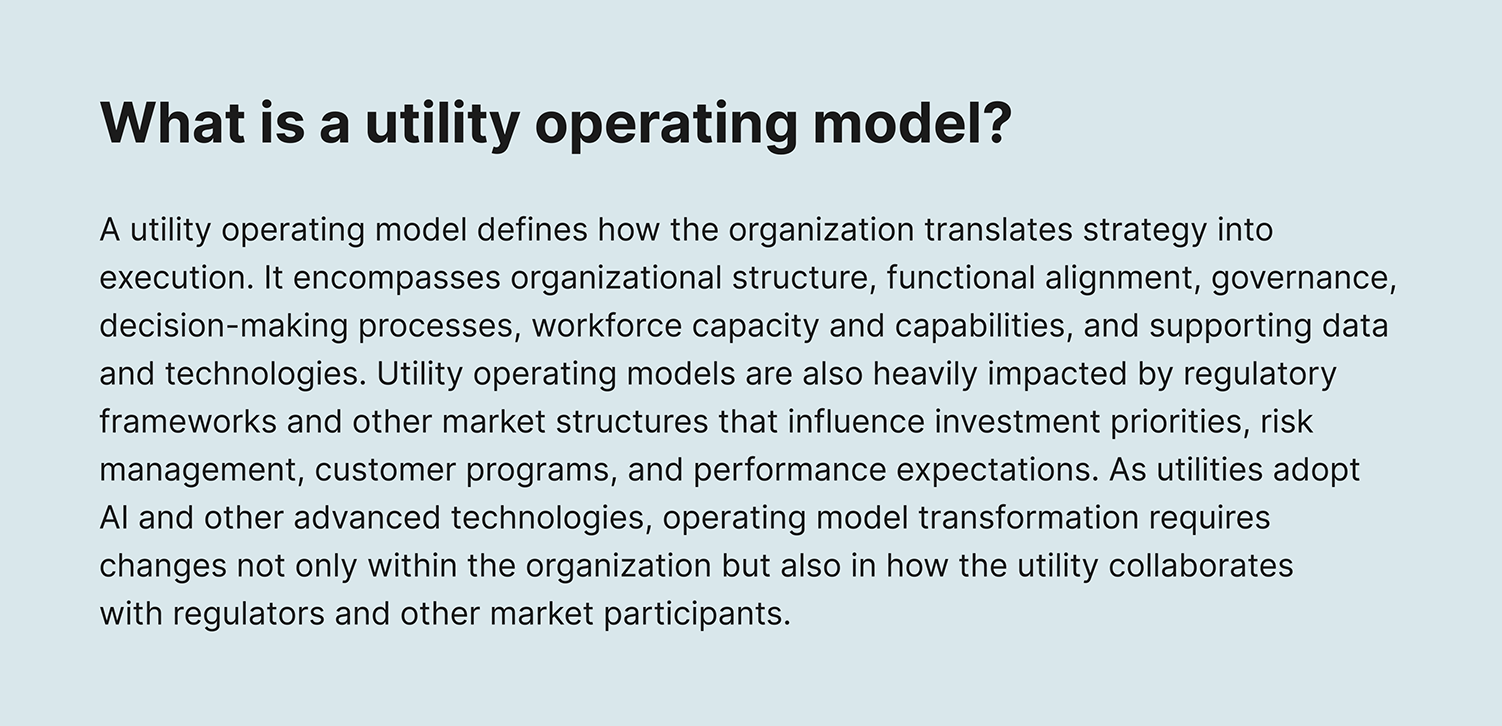
The core challenge inherent in the traditional operating model is that many of the opportunities with the greatest transformative potential span multiple business units and functions. Consider advanced metering infrastructure (AMI) data. At many utilities, AMI remains largely confined to billing and basic outage management despite its potential to inform asset management, load forecasting, customer engagement, demand response, and DER planning. AI can help unlock additional insights from this data, but realizing AMI’s full value requires coordination across business units, shared data governance, and aligned decision-making processes. In organizations where data, systems, teams, and workflows remain siloed, utilities can scale individual AI models but struggle to capture the broader operational and customer outcomes those models were designed to enable.
Although most utilities have modernized their infrastructure and technologies, many continue to operate within organizational and governance structures that haven’t significantly changed in decades. These operating models were designed for an era of centralized generation, predictable demand, and clearly defined functional boundaries. Today’s environment is markedly different. Planning decisions increasingly depend on customer adoption of distributed resources. Grid operations must respond dynamically to variability and extreme weather. Capital investments have systemwide implications that extend beyond any single function. And customers increasingly expect the flexibility, predictability, and control that have become commonplace in other industries. AI amplifies these interdependencies by exposing the seams between functions, datasets, and decision authorities—and that surfaces the following systemic challenges.
Data fragmentation limits the ability to train and deploy models that operate across the enterprise. Without common definitions for assets, customers, circuits, and work orders, even well-designed AI solutions struggle to scale beyond their originating function.
Funding and incentives are often misaligned with how AI creates value. Cross-functional use cases can require investment from one part of the organization while generating benefits in another. In the absence of shared funding models and enterprise prioritization, these opportunities are difficult to justify and rarely pursued at scale.
Lines of accountability for value realization are blurred. Often, no single leader owns outcomes across end-to-end processes, making it difficult to measure, capture, and sustain benefits. These challenges aren’t new, but AI makes them more evident.
To fully capture the value of AI, utilities must shift from a function-centric model to one organized around end-to-end value streams. This shift represents the foundation of the AI-native utility.
Instead of optimizing within discrete functions, AI-native utilities align around the cross-functional processes that drive outcomes. Four areas are particularly critical: capital planning and implementation, grid operations, customer experience, and demand growth. These domains cut across planning, engineering, operations, customer engagement, and regulatory strategy, requiring coordinated execution across the enterprise.
Consider capital planning and implementation. In the traditional model, planning, engineering, procurement, and construction are segmented processes, each optimized independently. AI may improve forecasting accuracy or scheduling efficiency within individual steps, but the largest value lies in optimizing the entire pipeline, from identifying system needs to delivering projects on time and on budget. Achieving that outcome requires integrated data, shared accountability, and coordinated decision-making across functions. Without redesigning the operating model, AI can’t deliver this level of integration.
The same principle applies to grid operations, where real-time decision-making increasingly depends on inputs from forecasting, distributed resource management, and customer participation. Similarly, for customer solutions, the areas of program design, enrollment, and system impacts are all tightly interconnected.
By organizing around value streams instead of functional silos, utilities can deploy AI to measurably boost efficiency (see below) and optimize outcomes that matter companywide.

Operating model transformation begins with governance that’s aligned with end-to-end business outcomes and value generation. Utilities must establish clear ownership of value streams, define metrics that measure enterprise performance, and create mechanisms for coordinating decisions across historically siloed organizations. This includes structures for prioritizing initiatives, managing interdependencies and risk, tracking performance, aligning resources, and continuously adjusting course as business needs evolve. Without this foundation, even the most advanced AI capabilities risk being constrained by fragmented decision-making and competing functional priorities.
As these governance mechanisms are put in place, utilities should establish an enterprise AI transformation office to accelerate and coordinate AI adoption across the organization. With cross-functional authority, this office helps define strategy, prioritize investments, align resources, establish standards for data and model governance, and verify that AI initiatives remain aligned with enterprise value creation.
Instead of managing a collection of disconnected use cases, the AI transformation office serves as a catalyst for achieving broader business outcomes through coordinated transformation. The following elements are essential to making this model work.
Data governance must be treated as an operating model issue, not solely a technical one. This means defining data ownership at the enterprise level, standardizing key concepts, and ensuring that data is accessible and usable across functions.
Funding models must evolve to support enterprise AI. Utilities need mechanisms to pool investment, prioritize initiatives based on overall value, and allocate costs and benefits to reflect cross-functional impact. This may include creating enterprise AI portfolios, establishing shared budgets, and standardizing approaches to benefit attribution.
Accountability ultimately converts AI from a collection of technology investments into measurable business outcomes. Utilities should assign clear ownership for realizing value, establish enterprise-level performance metrics, and hold leaders accountable for outcomes that span organizational boundaries. This helps capture, sustain, and continuously improve benefits over time.
Transforming the operating model also requires upskilling the workforce. AI changes how decisions are made, shifting work from manual analysis to AI-assisted insight generation. This affects roles across the organization, from planners and engineers to operators, customer service representatives, and executives.
To support this transition, utilities must invest in new skills and redefine responsibilities. Employees need to understand how to interpret model outputs, integrate them into decision-making, and oversee performance. At the same time, organizations must create mechanisms to accelerate adoption—and they need to ensure that change is made with an ethical best-practice lens for the use of AI.
As part of an AI transformation office, specialized AI-focused teams that work across the organization could be deployed to develop use cases, support implementation, and drive change. These teams serve as connectors between technical capabilities and business needs, helping embed AI into day-to-day operations.
Leading industries are already demonstrating that AI’s value is unlocked through operating model transformation, not isolated use cases. In banking, institutions such as DBS and JPMorgan have restructured around centralized AI platforms paired with embedded, cross-functional teams accountable for end-to-end workflows.
Retail and technology leaders have established enterprise AI centers of excellence to coordinate execution across business units, while life sciences companies such as Novartis have integrated data across the full value chain to enable enterprise decision-making. In each case, the breakthrough came from redesigning how work is organized, how data is shared, and how value is owned across the organization.
As utilities invest hundreds of billions of dollars in grid upgrades and technology deployment, the ones that that apply these technologies within legacy operating models will achieve only incremental gains while carrying forward longstanding inefficiencies. By contrast, organizations that transform how decisions get made, how work gets done, and how value gets delivered stand to realize the outsized financial and operational returns that will be a hallmark of the next-generation AI-native utility.

Michelle Fay, Partner
Ted Walker, Partner
Erik Larson, Partner
Richelle Elberg, Managing Consultant
Guidehouse is a global AI-led professional services firm delivering advisory, technology, and managed services to the commercial and government sectors. With an integrated business technology approach, Guidehouse drives efficiency and resilience in the healthcare, financial services, energy, infrastructure, and national security markets.